
Another wild goose chase.

I was convinced that cubic maps on the sphere without F2, F3, and F4 faces were forced to have large clusters of F5 faces. But I’ve actually found an infinite family of counterexamples showing that it is possible to build maps of arbitrary size, with faces of arbitrary size, with no face smaller than a pentagon, and with every pentagon kept strictly isolated from every other.
Anyway, I don’t mind chasing wild geese, quite the contrary actually, because this wonderful theorem keeps showing me things I didn’t know, bringing me to the work of people I didn’t know.
Surgery on a sea of hexagons
Everything below happens far out in the hexagonal ocean of a giant Goldberg map. See Fullerene structure or Goldberg polyhedron for details.
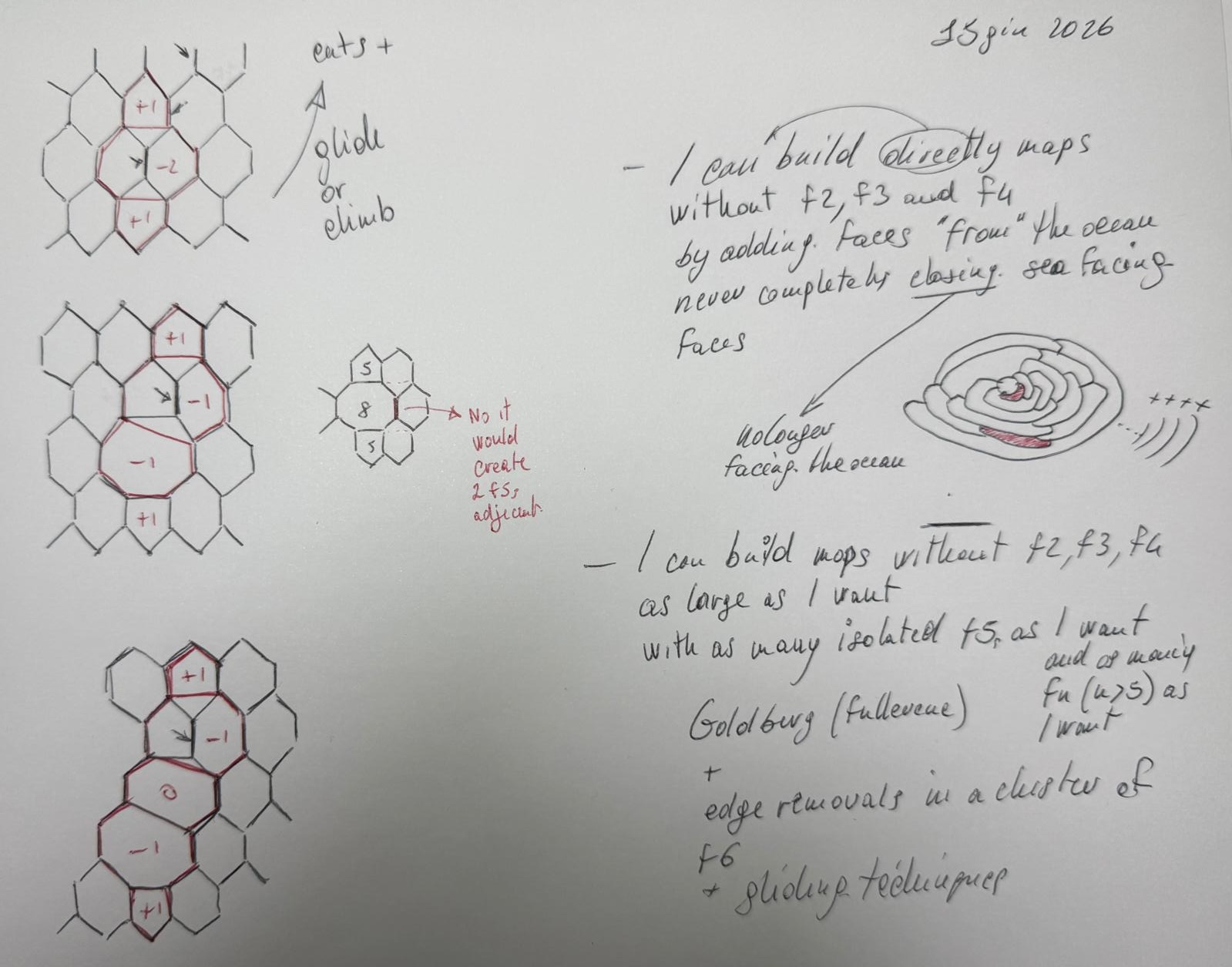
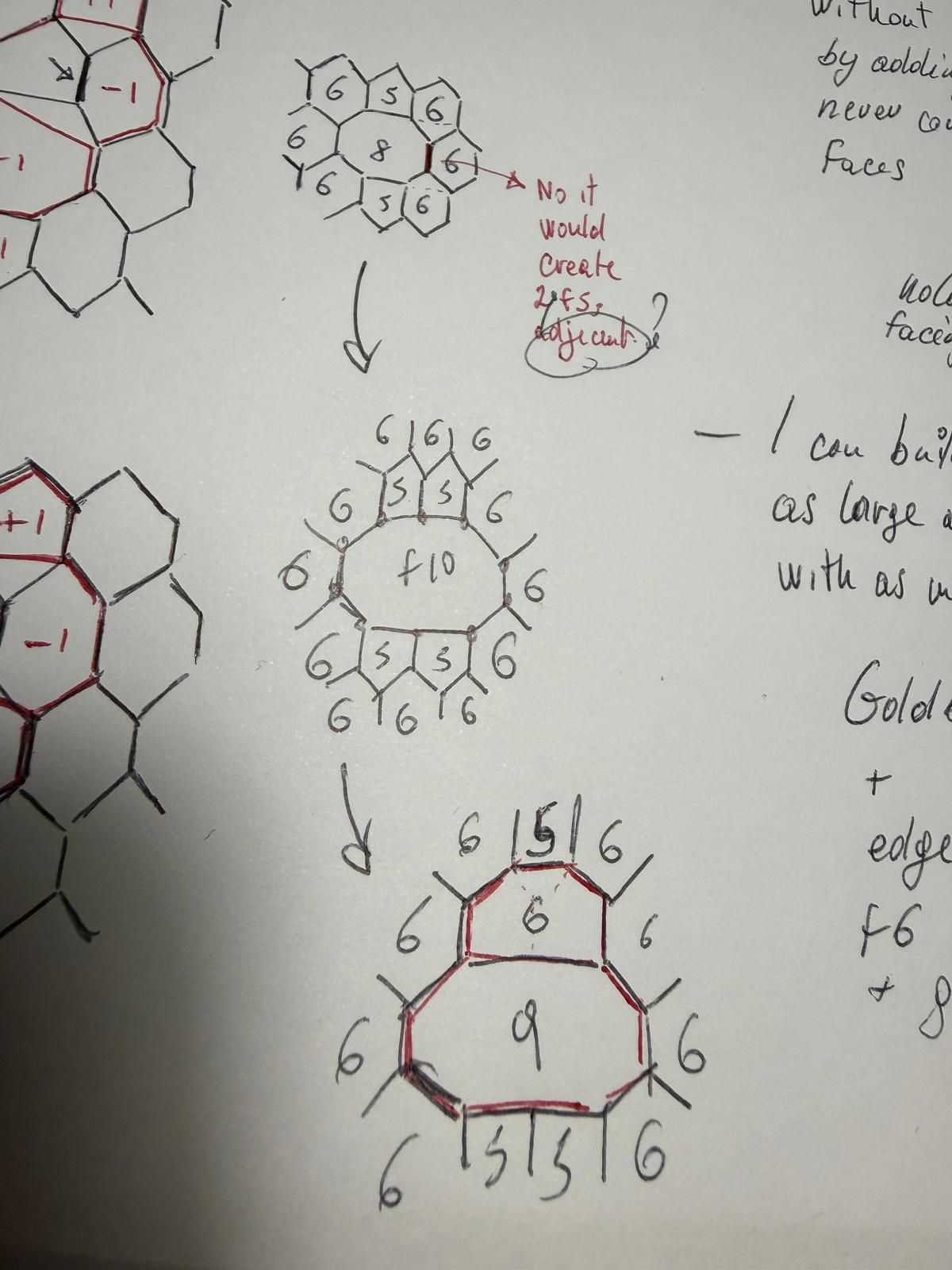
The basic act of surgery is brutal and simple: delete one edge together with its two endpoints, and smooth the two resulting degree-two corners. Four faces feel it. The two faces that shared the edge merge into one face of size a+b−4 (6+6−4=8 sides); the two flanking hexagons drop to pentagons. This is the famous 5-8-5 defect of graphene physics (a reconstructed divacancy: two missing atoms) Volterra studied. Net charge: +1−2+1=0. Crucially, the surrounding ring of hexagons is combinatorially untouched. The defect is invisible from one ring away.
From there, the whole game is choosing the right edge so that the F5 face glides over the ocean to be kept as isolated as wanted.
I was already familiar with Paul Wernicke and Philip Franklin, who hunted the Four Color Theorem by proving unavoidability results: in any cubic spherical map with all faces of size at least five, some pentagon must sit next to a face of size at most six (Wernicke), in fact, next to two such faces (Franklin). Their method, discharging, the art of letting positive charge flow along edges until a contradiction surfaces, is the ancestor of the 1976 computer proof of the Four Color Theorem.
Victor Eberhard, a German geometer who lost his sight as a young man and did all of this work blind, proved in 1891 that any face-count sequence satisfying the law of twelve can be realized by an actual polyhedron, provided you are allowed to throw in enough neutral hexagons. Eberhard’s theorem is the existential backbone of everything here: the hexagons are the silent majority that makes any charge distribution geometrically possible
Vito Volterra, the great Italian analyst, supplied the deepest tool without knowing it. His theory of distorsioni in elastic bodies, cut the material, shift one lip of the cut by a lattice step, re-glue, is exactly the theory of dislocations that crystallographers and graphene physicists use today. On a hexagonal map, a Volterra cut-and-shift leaves a pentagon at one end of the seam and a heptagon at the other, with unharmed hexagons everywhere in between: a +1+1 and a -1-1, created in pairs, separable at will.
Michael Goldberg classified the highly symmetric cubic maps made of twelve pentagons and any number of hexagons, the Goldberg polyhedra, rediscovered by chemists as fullerenes and by virologists in virus capsids. A giant Goldberg map is the perfect blank canvas: a near-infinite sea of neutral hexagons with twelve pentagonal hills parked at the corners of an icosahedron, as far from each other as you please.

