4CT and loops, cycles, circuits, chains, paths


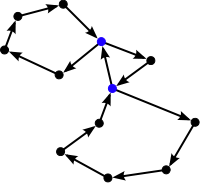
I realized that for some posts I may have used “Kempe loops” and “Kempe cycles” to describe closed “Kempe chains”, that in other words form closed paths (cycles). I think it would have been better always to use “Kempe cycles”.

https://en.wikipedia.org/wiki/Loop_(graph_theory)

https://en.wikipedia.org/wiki/Path_(graph_theory)

https://en.wikipedia.org/wiki/Hamiltonian_path

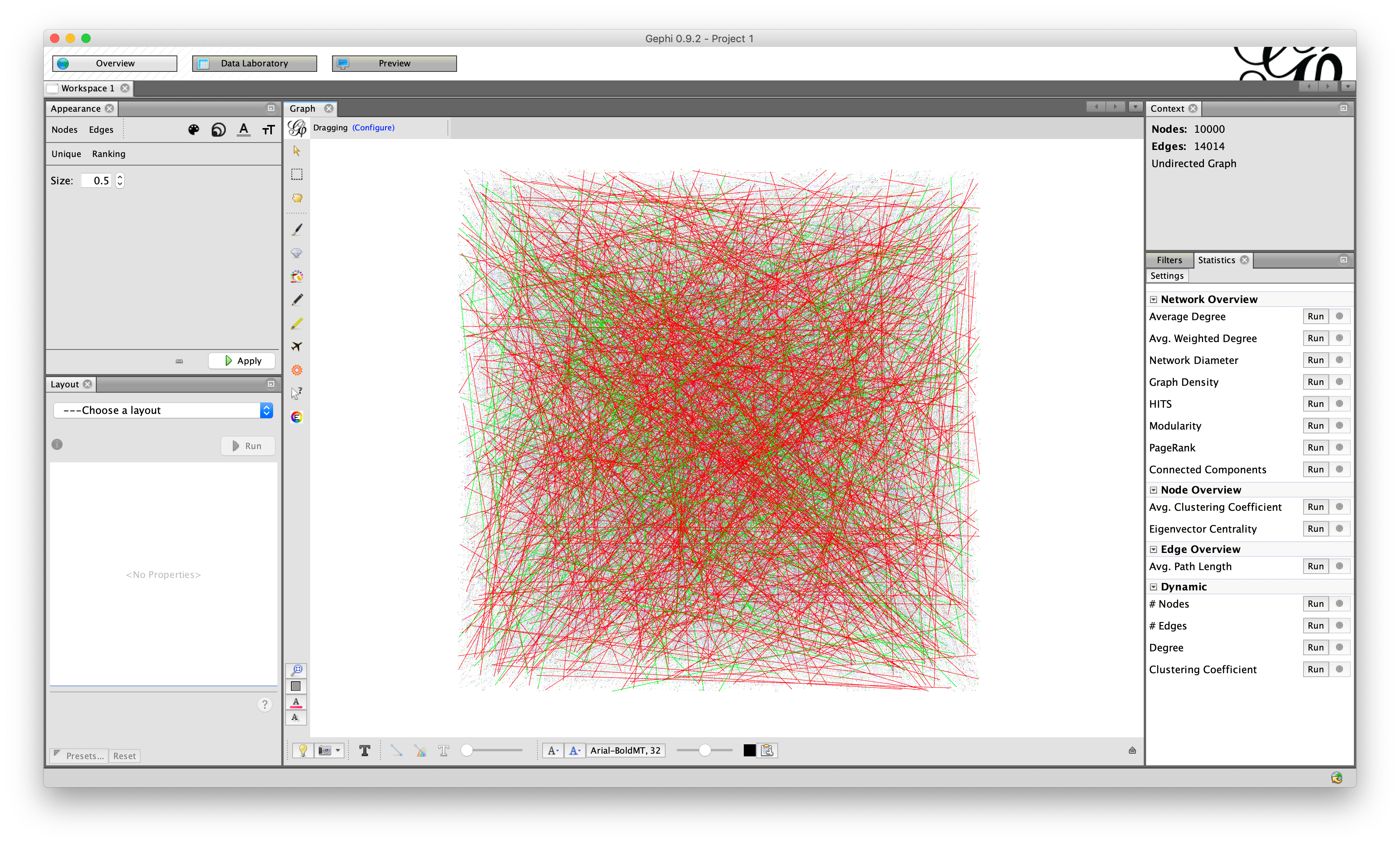
Zoom on a planar graph, 10000 nodes, three-edge Tait colored


I generated a planar map of 10000 nodes and then colored using the 4ct python coloring program.

It did use Tait coloring (3-edge-coloring) which is equivalent to the four face coloring of the four color theorem.

It works pretty fast using:

  • graph reduction removing edges from F2, F3, F4, F5
  • graph rebuilding using Kempe chain color switching techniques

Four color theorem: Infinite switches are not enough – Rectangular maps :-(


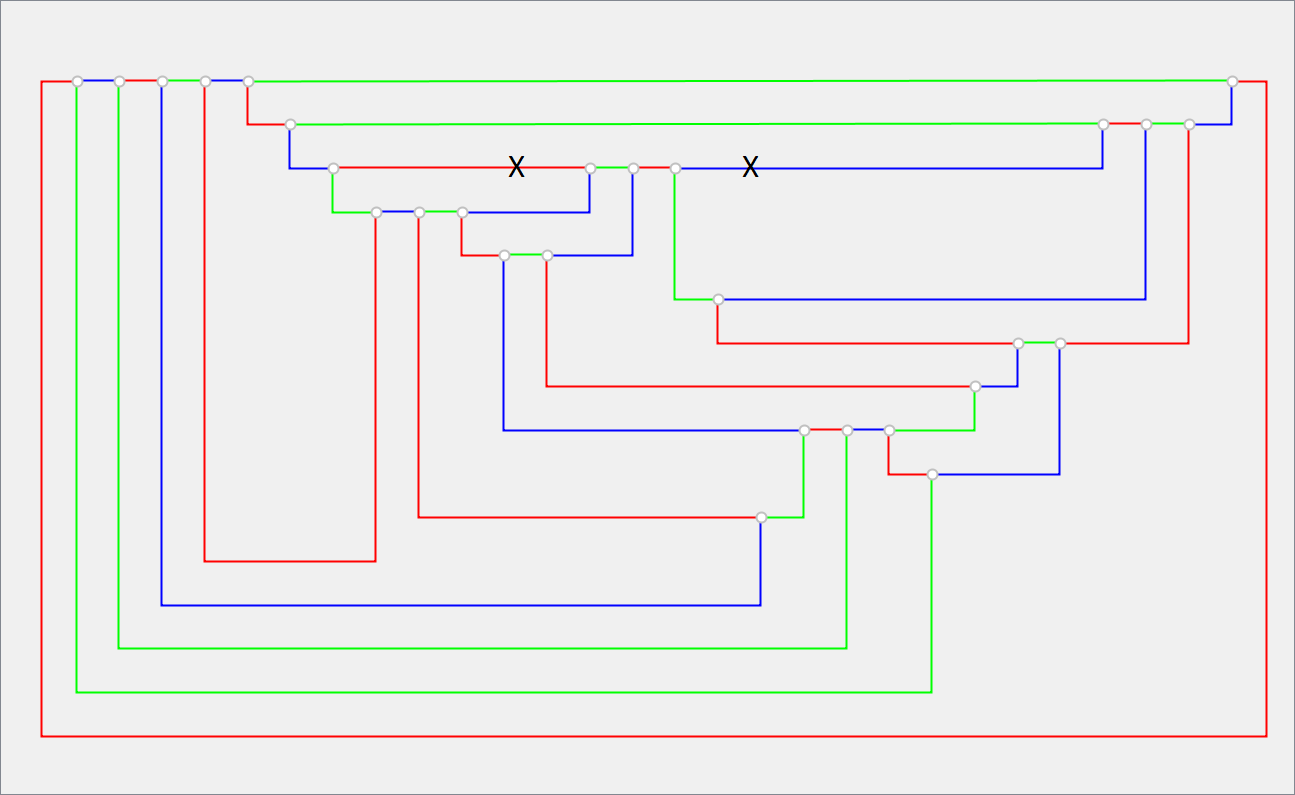
I transformed the really bad case into a rectangular map to play with the Java program and Kempe random switches.

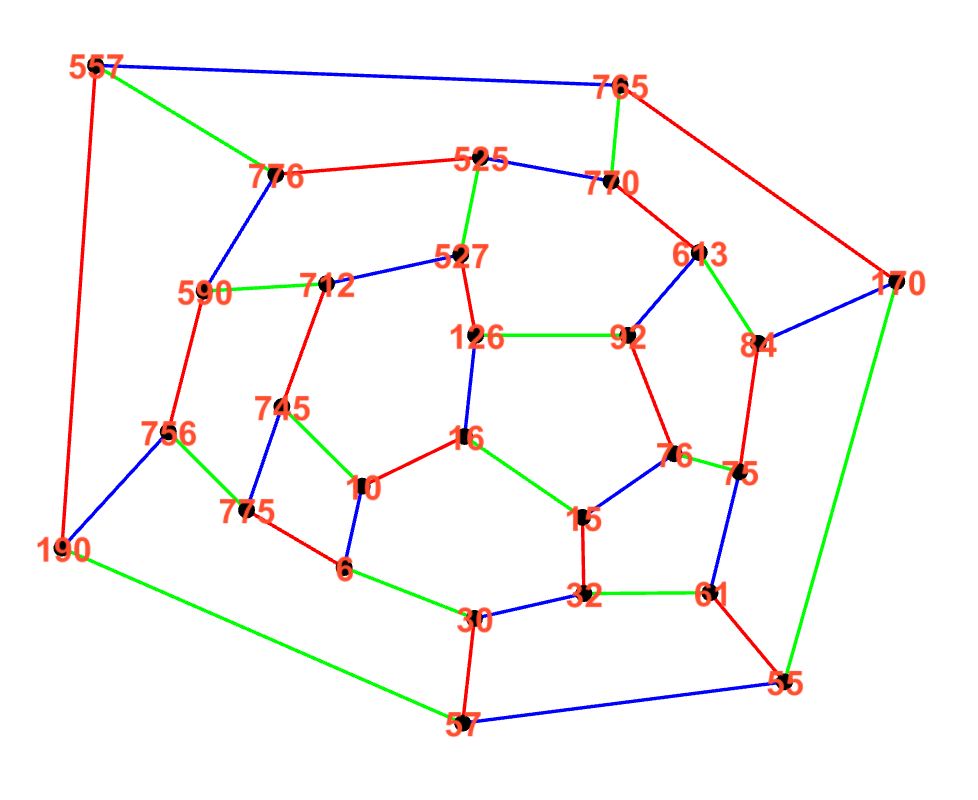
Here is the graph with the two edges to connect:

save-graph-really-bad-case

The two edges marked with the X, have to be joined by a new edge that form a new F5 face.

To try the Java program, rebuild this graph and play with the switches, it is possible to use this string:

  • 1b+, 2b+, 3b+, 4b+, 5b+, 15b+, 14b-, 13b-, 5e-, 6b-, 12b-, 4e-, 8b-, 13e-, 6e-, 9b-, 12e-, 11b-, 3e-, 14e-, 10b-, 7b-, 2e-, 8e-, 9e-, 11e-, 7e-, 10e-, 15e+, 1e+

Next is the graph that shows how the graph has been converted:

really_bad_case-ariadne_step-5-12-7-32-6-15-10-ppt

Four color theorem: one switch is not enough :-(


Experimenting with the Python program, I have found that if you have an F5 impasse, a single switch may not be enough to solve the impasse. It means: counterexample found.

This is a bad news, since I believed that a single switch, on an appropriate edge, could have been the key to solve the theorem.

BUT

Since a limited number of switches still work, I am going to study if two switches, on appropriate edges, may work.

🙂

Four color theorem: sage and multiple edges


Implementing, using Sagemath, the algorithm of Kempe reduction and the half Kempe chain color swithing (for Tait coloring), I need to avoid multiple edges and loops … OR I’ll not be able to use functions that need embedding, as for example faces(), is_planar() and others.

Some notes:

kempe-half-cycle-swapping-method-sage-and-multiple-edges

Four color theorem: down to a single case!


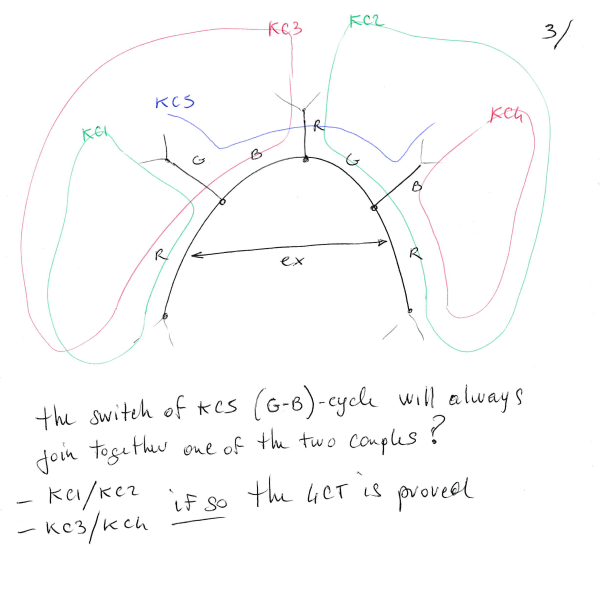
This post follows directly the previous one. I’m down to a single case to prove (pag. 3).

kempe-half-cycle-swapping-method-F5-third-page-v2

I think I should move to Java coding, implementing the entire algorithm: map reduction (removing edges), color reduced map, restore of edges one at a time, adjust the coloring to the case to prove (e2 = red), apply Kc5 color switching, …, apply the half Kempe-cycle color switching.

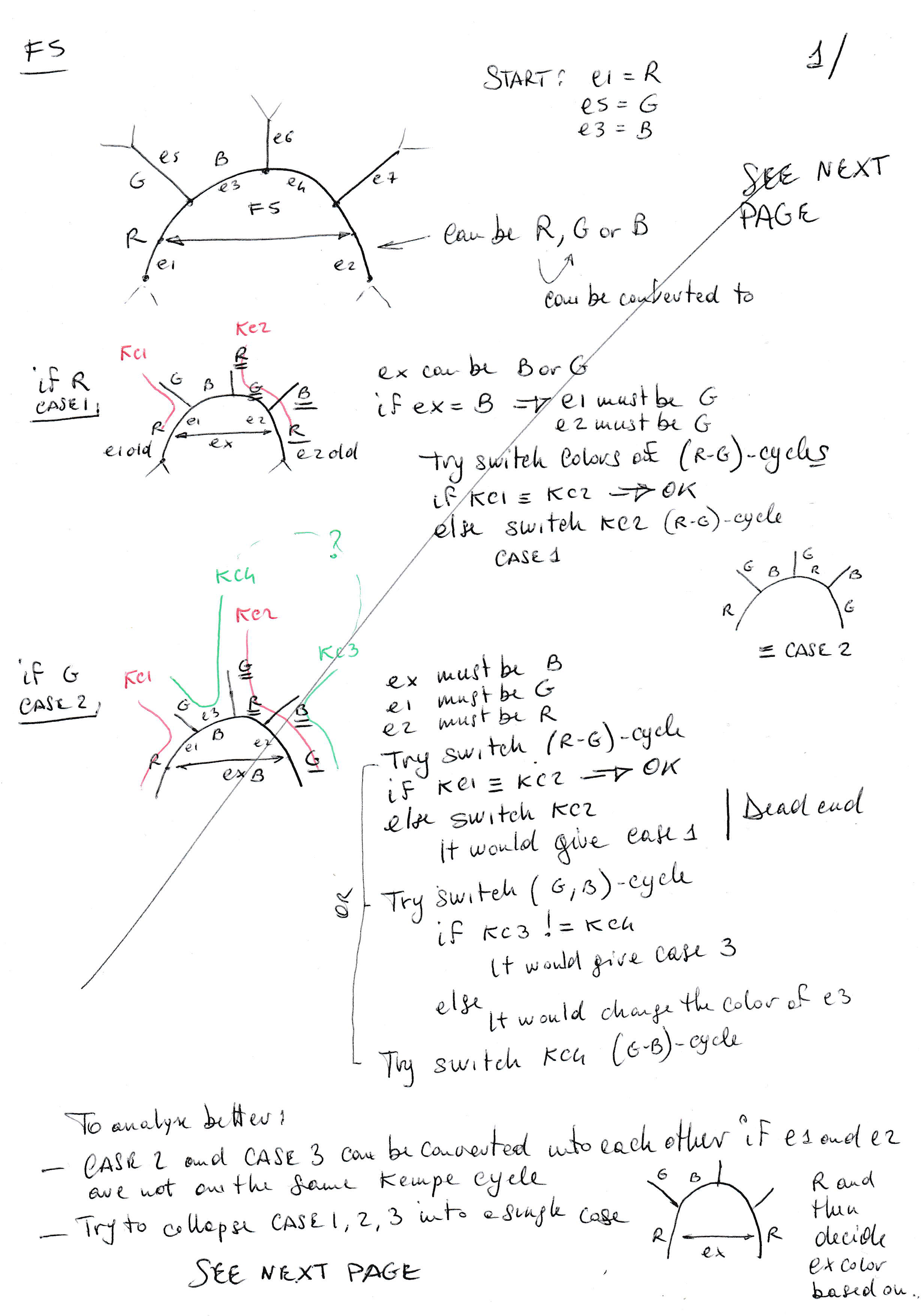
Notes (pag. 1 and 2):

kempe-half-cycle-swapping-method-F5-first-page

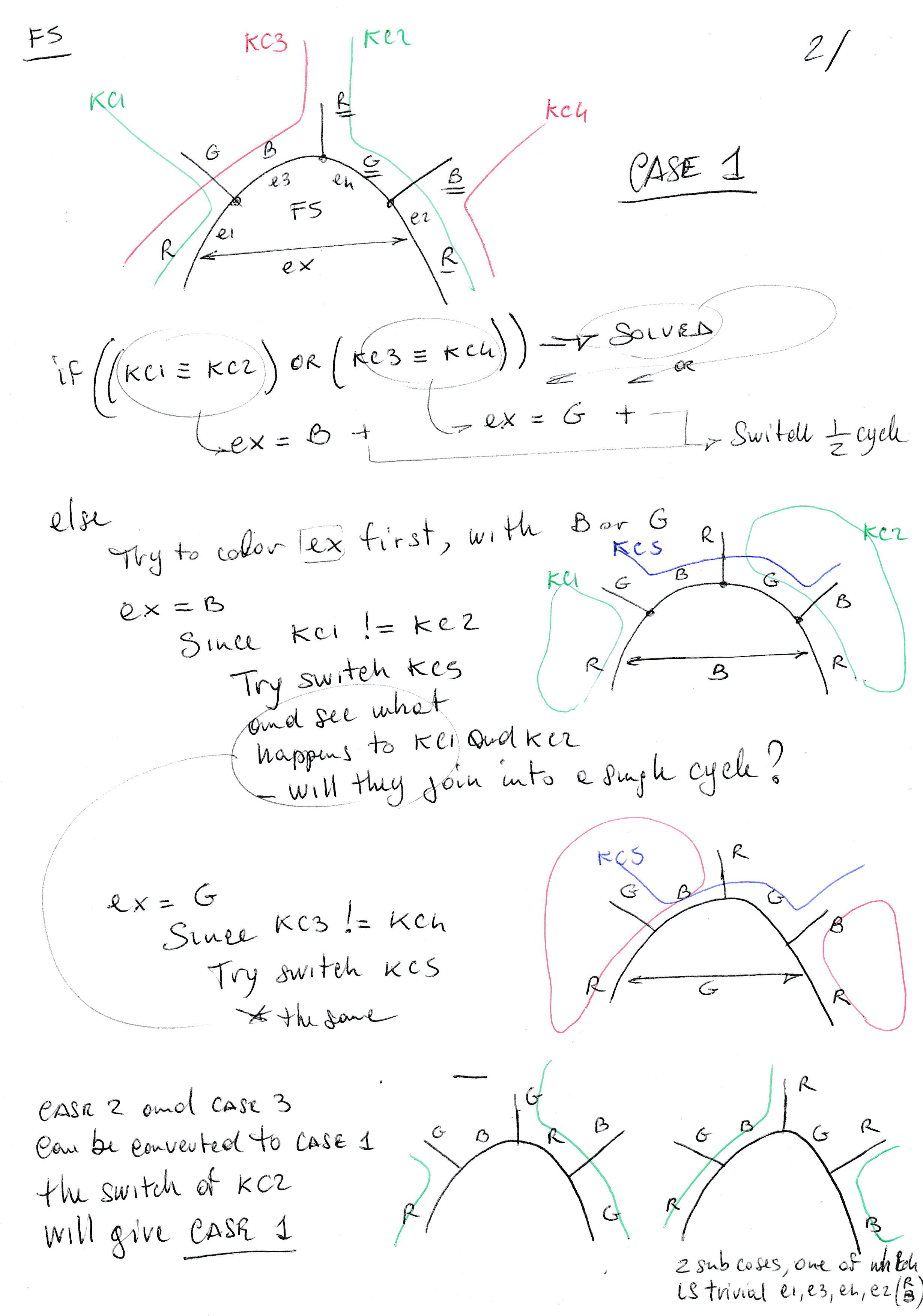
Second page:

kempe-half-cycle-swapping-method-F5-second-page

Four color theorem: experimenting impasses (as in life)


I still think a solution may be found in Kempe chain color swapping … for maps without F2, F3 and F4 faces (or even without this restriction).

Or at least I want to try.
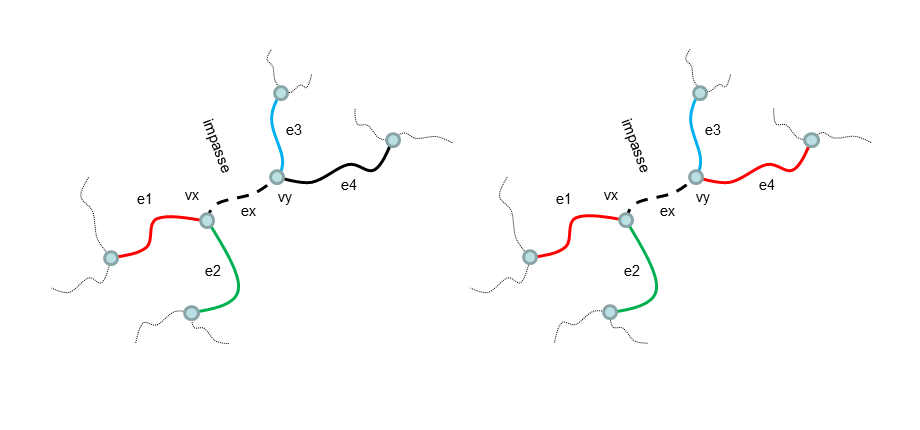
kempe-chain-impasse-v2

How you can solve the impasses (To be finished):

To explain the possible cases, without lack of generality, I can assume to start with these colors: e1=red, e2=green, e3=blue, e4=red. e4 may also be colored in green, the reasoning will not change much.

  1. If e3 and e4 are not colored … there is no impasse → OK
  2. If e3 is the same color ex should be (blu in the example) and e4 is non colored
    1. If one of the two possible chains starting from e3: (b, r)-chain or (b, g)-chain does not end at e1 or e2
      1. Use it to swap the color of e3 and solve the impasse → OK
    2. If both end at e1 or e2
      1. Try to deroute one of the two chains, using another kempe chain color swapping along the way, to fall into one the the solvable cases (2.A)
        1. If the derouted original chain does not longer end at e1 or e2, then apply the original kempe chain color swapping and solve the impasse → OK
        2. If deroute does not work
          1. … TBV: It seems that swapping colors around solve all type of impasses
  3. If e3 is the same color ex should be, and e4 is also colored
    1. In this case the chain (…-e3e4-…) = (b, r)-chain would simply swap the colors of e3 and e4 and therefore will not solve the impasse. It is better to use the other (b, g)-chain, starting from e3
      1. If this chain does not end at e2 (e1 is not a possible end because the chain is blue and green), use it to swap the color of e3 and solve the impasse → OK
      2. If it ends at e2
        1. Try to deroute the chain, using another kempe chain color swapping along the way, to fall into one the the solvable cases
        2. If deroute does not work
          1. TBV: It seems that swapping colors around solve all type of impasses

A deroute of a chain appears as in the next picture. Consider that deroutes may not work because Chain-B color swapping may change one or more of the three edges e1, e2, e4, and after appying the Chain-B swap, the chain starting with a3, may still end to one to e1, e2, e4. See this post for a real example: here.

kempe-chain-deroute-v2

About swaps of a partially colored map, I’ve asked a question on mathoverflow … here.

Maybe I was wrong when, in the motivation of the question (mathoverflow), I said that “I found many examples in which Kempe chain color swapping does not work for maps with faces of type F2, F3, F4, but I did not find an example of maps with only F5 or higher“. It seems to be possible also for maps with F2, F3, F4.

I’ll continue to search for counterexample but, for what I’ve seen so far (I tryed about 50 maps) it has been always possible to solve impasses, only proceeding by swapping colors.

This is one of the map that I thought to be a counterexample, but it is not. Its signature is:

  • 1b+, 9b+, 9e+, 3b+, 5b+, 7b+, 12b+, 10b-, 11b-, 5e-, 7e-, 4b-, 3e-, 2b-, 10e-, 4e-, 6b-, 11e-, 12e+, 8b+, 8e+, 6e+, 2e+, 1e+
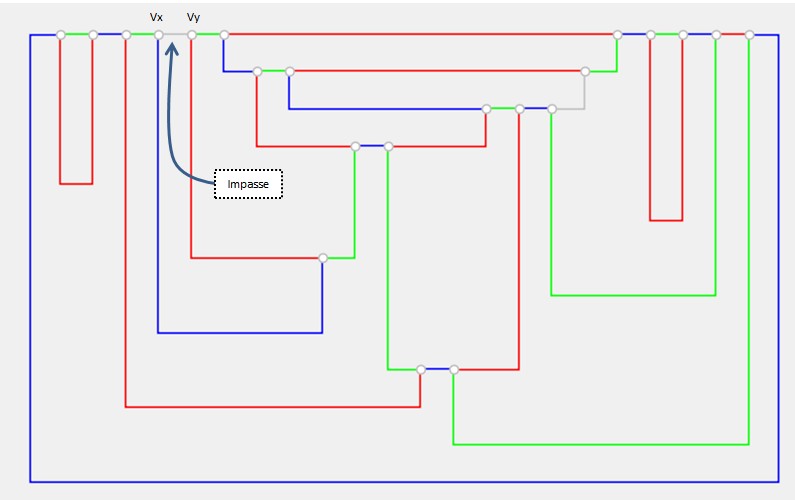
impasse-in-map-not-simplified

Something else to check:

  • Since once completely colored, all chains are actually loops, when it comes to the last two impasses, if you solve one impasse also the other one gets solved!

Four color theorem: Cahit spiral chains and Tait coloring


I was experimenting impasses and I found this about spiral chains:

  • Consider all possible maps less than or equal to 18 faces (including the ocean)
  • Do not consider duplicates (isomophic maps)
  • There is still a very large number of possible such maps
  • Remove all maps that have faces with 2, 3, 4 edges
  • The number of maps reduces to 22 maps only
  • All these 22 maps have only one spiral chain
  • To get the Tait coloring, required me only one Kempe chain color swapping per map
  • Actually I complitely colored the spiral (the backbone) with two colors and then I finished the other edges and at the end I worked on impasses
  • Next, I’ll try the algorithm described here:

Four color theorem: counterexample to the hypothesis I was verifying :-(


Bad news … to me!

This example it is a counterexample to the hypothesis I was trying to verify!

Map signature: 1b+, 4b+, 6b+, 15b+, 7b-, 14b-, 8b-, 12b-, 13b-, 11b-, 9b-, 8e-, 7e-, 5b-, 6e-, 9e-, 10b-, 5e-, 4e-, 3b-, 10e-, 11e-, 12e-, 3e-, 2b-, 13e-, 14e-, 15e+, 2e+, 1e+

😦

For this example, no Kempe color switching exists along the main chain (b-r) = (1-2-3-4-5-6-7-8) that “divert” it, to make it end at a different vertex than vx. All other chains (*-g) along the main chain (b-r) involve vx or vy.

hypothesis-counterexample-v2