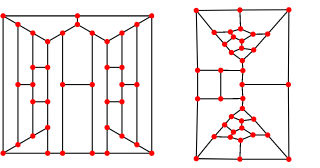
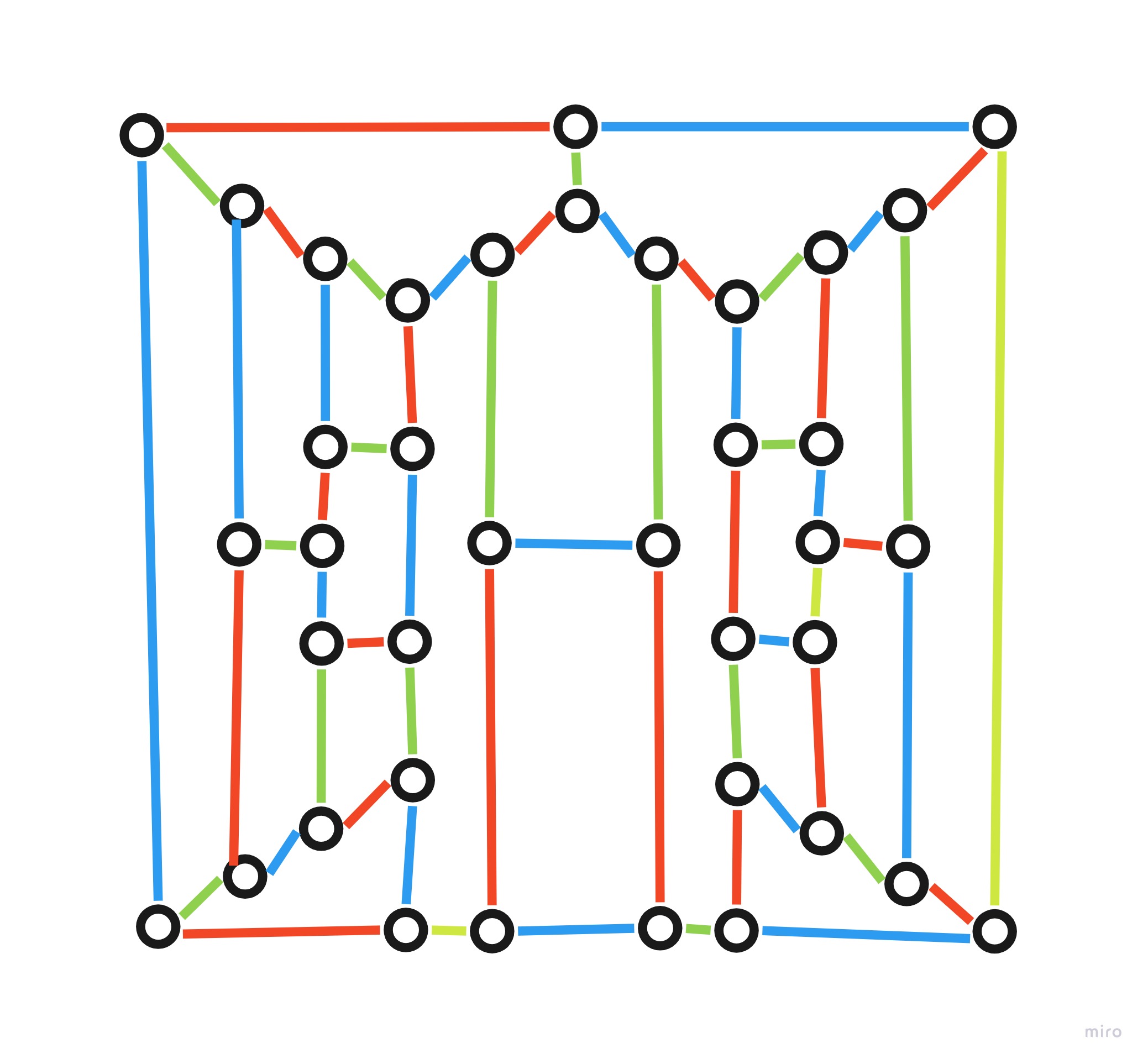
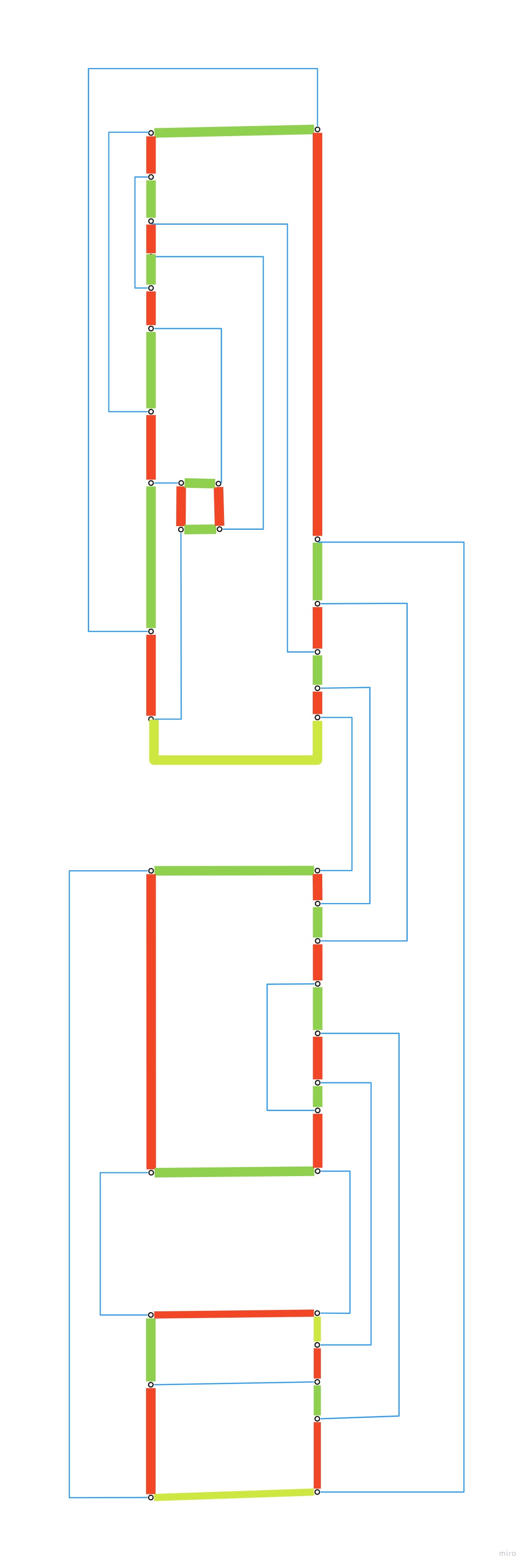
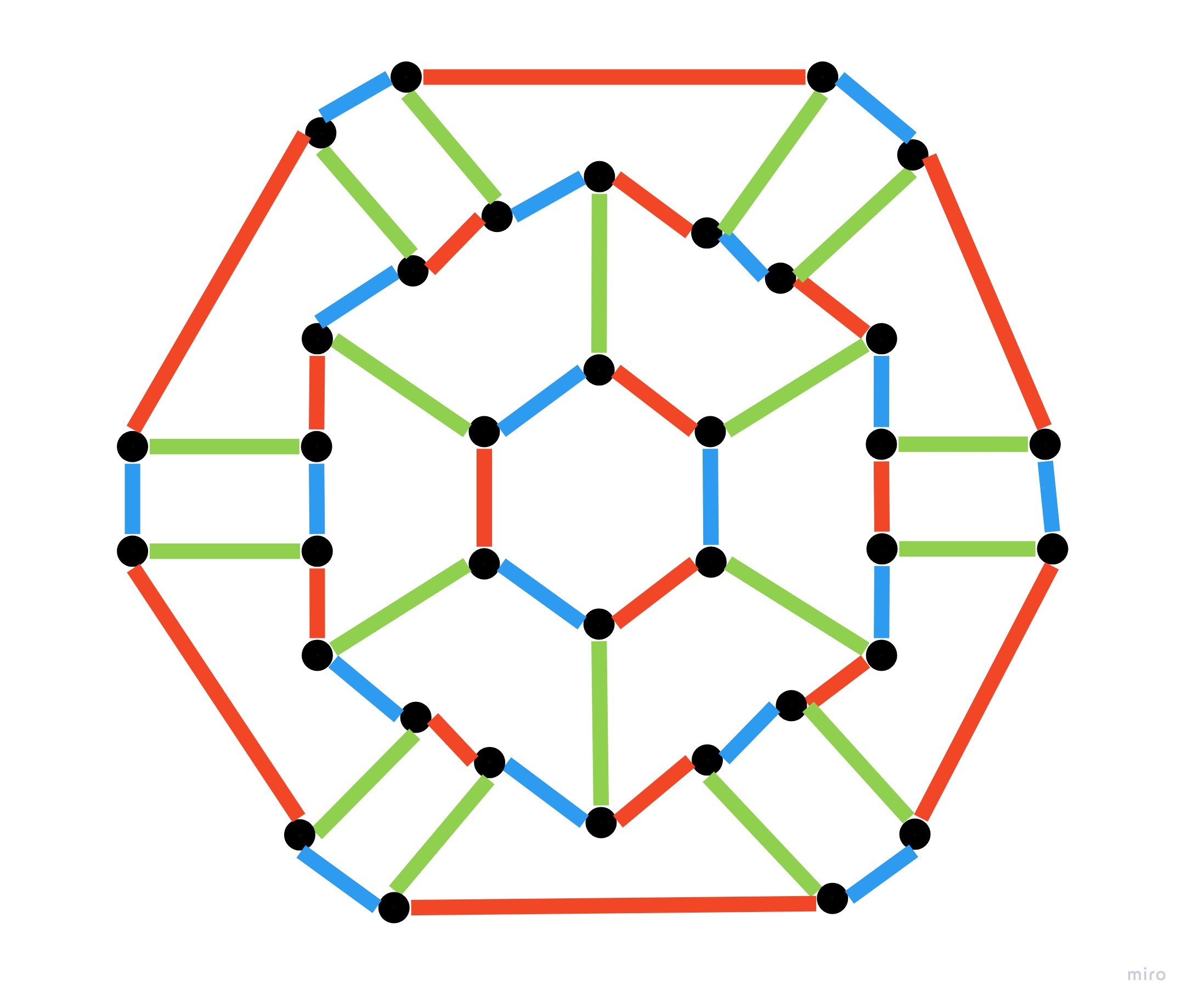
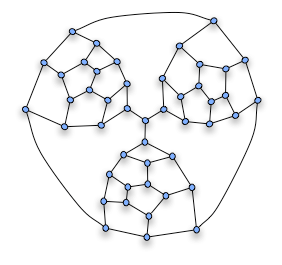
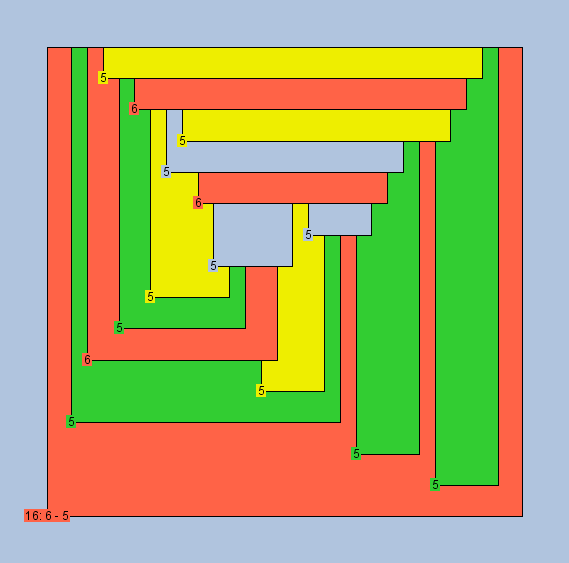
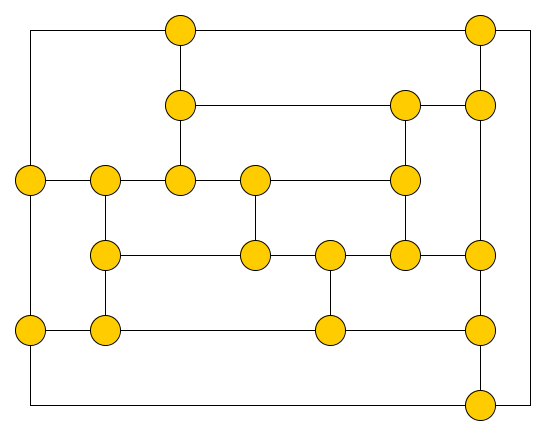
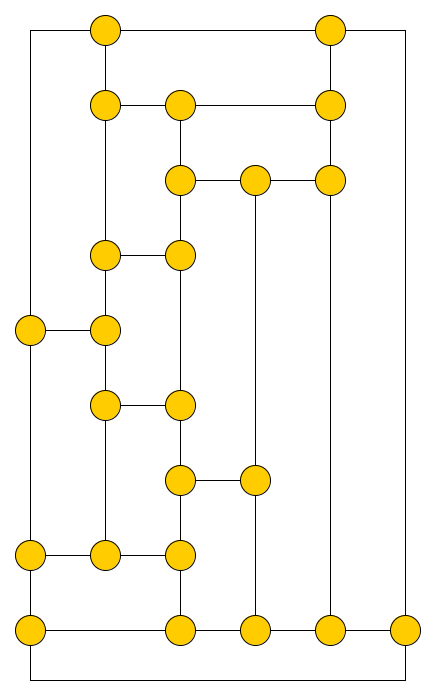
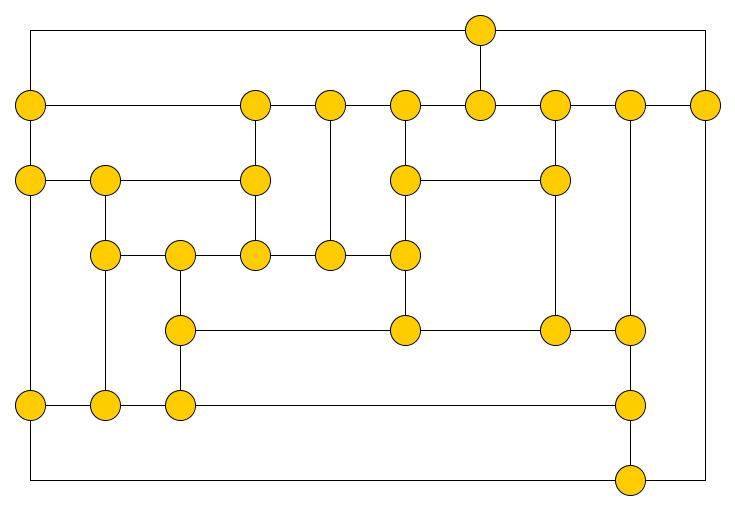
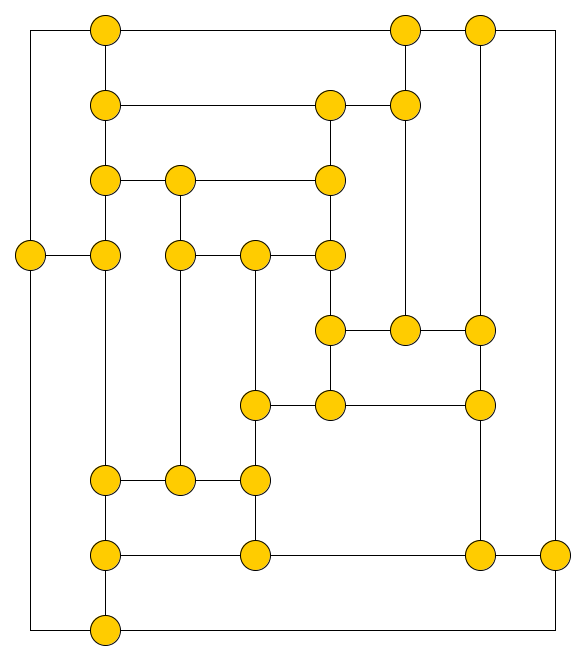
Considering the smallest known non-Hamiltonian 3-regular planar graphs, discovered by Barnette-Bosák-Lederberg, I computed the Tait coloring and then deformed it to put in evidence the R-G cycles that in this case are four.
Q2) Verify if at least one of the cycles (R-G, R-B, or G-B) form an Hamiltonian circuit
False.
From the Tait’s conjecture we now know (now = 1946 by William Thomas Tutte) that 3-regular graphs exist also without an Hamiltonian circuit. It means that, no matter what, it is not possible to find a cycle that touches all vertices, and therefore no single Kempe cycles of any two color selection, can exist.
From Wikipedia, the free encyclopedia
This article is about graph theory. For the conjectures in knot theory, see Tait conjectures.
In mathematics, Tait’s conjecture states that “Every 3-connectedplanarcubic graph has a Hamiltonian cycle (along the edges) through all its vertices“. It was proposed by P. G. Tait (1884) and disproved by W. T. Tutte (1946), who constructed a counterexample with 25 faces, 69 edges and 46 vertices. Several smaller counterexamples, with 21 faces, 57 edges and 38 vertices, were later proved minimal by Holton & McKay (1988). The condition that the graph be 3-regular is necessary due to polyhedra such as the rhombic dodecahedron, which forms a bipartite graph with six degree-four vertices on one side and eight degree-three vertices on the other side; because any Hamiltonian cycle would have to alternate between the two sides of the bipartition, but they have unequal numbers of vertices, the rhombic dodecahedron is not Hamiltonian. The conjecture was significant, because if true, it would have implied the four color theorem: as Tait described, the four-color problem is equivalent to the problem of finding 3-edge-colorings of bridgeless cubic planar graphs. In a Hamiltonian cubic planar graph, such an edge coloring is easy to find: use two colors alternately on the cycle, and a third color for all remaining edges. Alternatively, a 4-coloring of the faces of a Hamiltonian cubic planar graph may be constructed directly, using two colors for the faces inside the cycle and two more colors for the faces outside.
Next post will be on the four coloring of the barnette-bosák-lederberg graph, which is the smallest known non-Hamiltonian graph, and the analysis of its Kempe cycles.
Q3) What about if I start with finding cycles, of even length (# of edges), that cross all vertices?
Some initial considerations: If cycles have to fit with Kempe cycles (closed paths of two alternating colors), they have to be of even length, and that would also mean that the total number of vertices crossed by all the cycles of the same two colors should be even too. Is it like this, or am I missing something? What about graphs with an odd number of vertices? Am I missing something?
There are some methods around to create planar graphs. One of these is based on the Delaunay triangulation algorithm from which you can derive its dual, a 3 regular planar graph. Tools and libraries that I found around (sage, networkx and others), permits you to save the graph using one of common format to represent the graph itself, specifically: .dot, .graphml, .GEXF, .gpickle and others). One problem that I found is that if I save the graph I loose the planar representation of it.
Since for what I am trying to do, namely demonstrate with pencil and paper that the four color theorem has a simpler demonstration, I need to work directly with the planar representation of the graph.
I decided to implement my own method (based on edge addition to planar graphs. See “John M. Boyer and Wendy J. Myrvold, On the Cutting Edge: Simplified O(n) Planarity by Edge Addition. Journal of Graph Algorithms and Applications, Vol. 8, No. 3, pp. 241-273, 2004.”) to generate an save the graph directly using its planar representation. Get the code here at: https://github.com/stefanutti/maps-coloring-python. The program generates random planar graphs without using graphs library and most importantly without using complex algorithms, as planar embedding or planarity testing.
Planar embedding: “A combinatorial embedding of a graph is a clockwise ordering of the neighbors of each vertex. From this information one can define the faces of the embedding”.
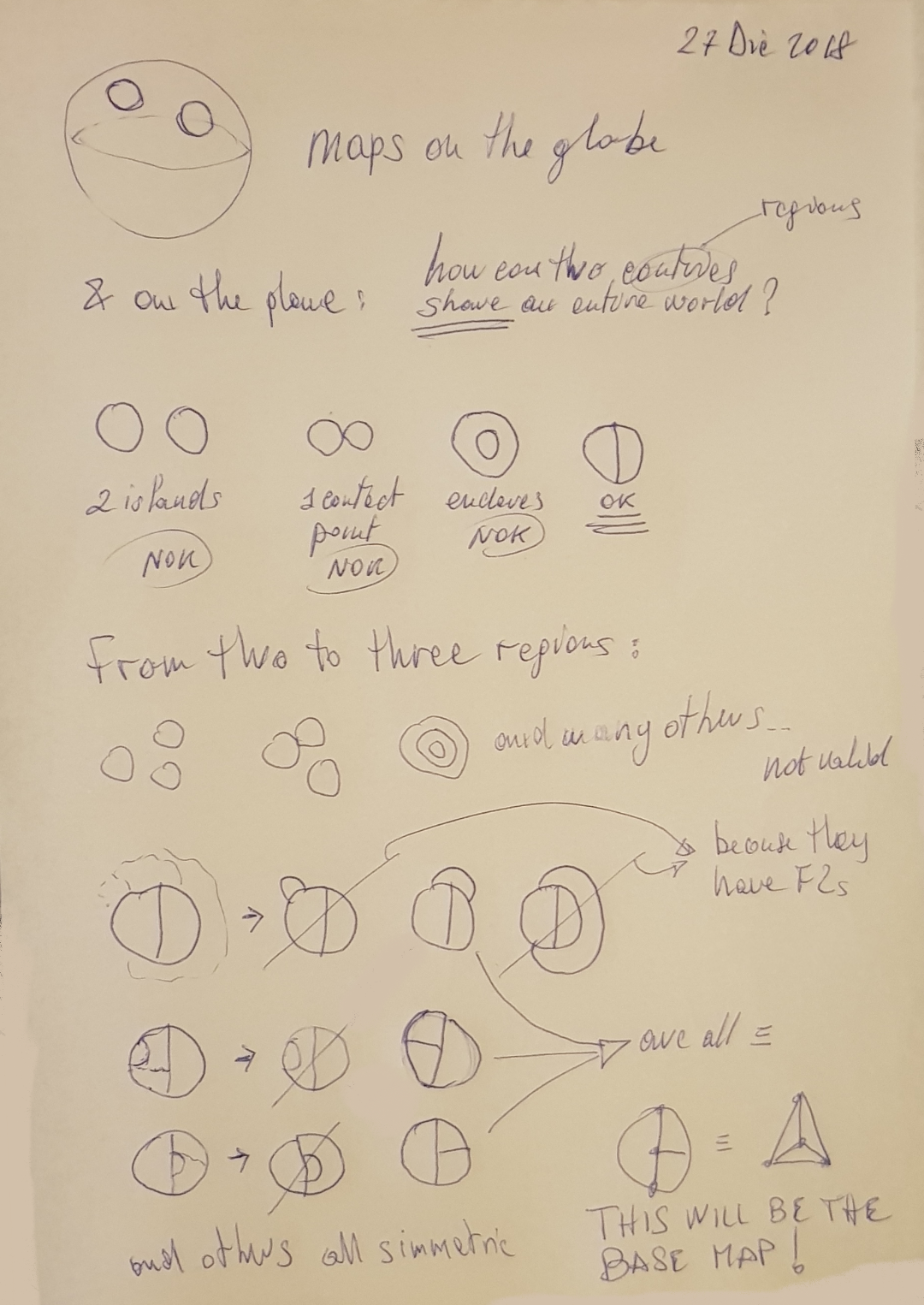
Edge addition can start from a basic graph of four faces (bottom right). In the third last line of this picture I added edges from a graph with 3 faces and 2 vertices (considering the ocean). But as you can deduct from the other pictures I can safely start from a graph with 4 faces and 4 vertices (bottom right).
I still think a solution may be found in Kempe chain color swapping … for maps without F2, F3 and F4 faces (or even without this restriction).
Or at least I want to try.
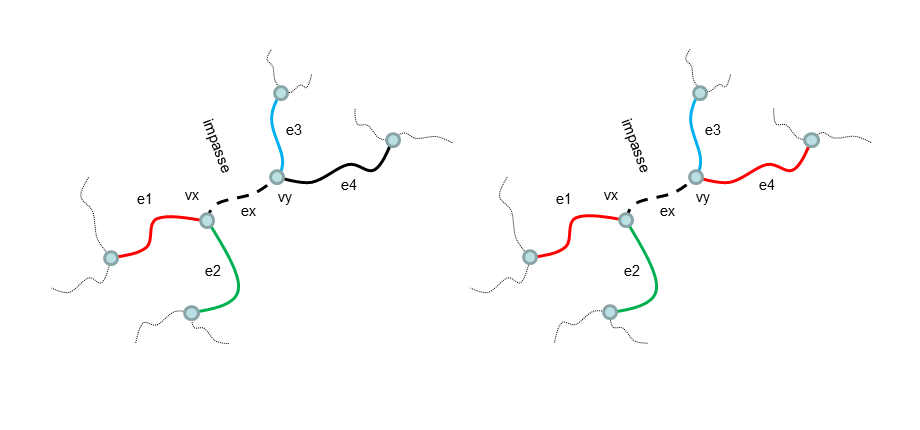
How you can solve the impasses (To be finished):
To explain the possible cases, without lack of generality, I can assume to start with these colors: e1=red, e2=green, e3=blue, e4=red. e4 may also be colored in green, the reasoning will not change much.
If e3 and e4 are not colored … there is no impasse → OK
If e3 is the same color ex should be (blu in the example) and e4 is non colored
If one of the two possible chains starting from e3: (b, r)-chain or (b, g)-chain does not end at e1 or e2
Use it to swap the color of e3 and solve the impasse → OK
If both end at e1 or e2
Try to deroute one of the two chains, using another kempe chain color swapping along the way, to fall into one the the solvable cases (2.A)
If the derouted original chain does not longer end at e1 or e2, then apply the original kempe chain color swapping and solve the impasse → OK
If deroute does not work
… TBV: It seems that swapping colors around solve all type of impasses
If e3 is the same color ex should be, and e4 is also colored
In this case the chain (…-e3–e4-…) = (b, r)-chain would simply swap the colors of e3 and e4 and therefore will not solve the impasse. It is better to use the other (b, g)-chain, starting from e3
If this chain does not end at e2 (e1 is not a possible end because the chain is blue and green), use it to swap the color of e3 and solve the impasse → OK
If it ends at e2
Try to deroute the chain, using another kempe chain color swapping along the way, to fall into one the the solvable cases
If deroute does not work
… TBV: It seems that swapping colors around solve all type of impasses
A deroute of a chain appears as in the next picture. Consider that deroutes may not work because Chain-B color swapping may change one or more of the three edges e1, e2, e4, and after appying the Chain-B swap, the chain starting with a3, may still end to one to e1, e2, e4. See this post for a real example: here.
About swaps of a partially colored map, I’ve asked a question on mathoverflow … here.
Maybe I was wrong when, in the motivation of the question (mathoverflow), I said that “I found many examples in which Kempe chain color swapping does not work for maps with faces of type F2, F3, F4, but I did not find an example of maps with only F5 or higher“. It seems to be possible also for maps with F2, F3, F4.
I’ll continue to search for counterexample but, for what I’ve seen so far (I tryed about 50 maps) it has been always possible to solve impasses, only proceeding by swapping colors.
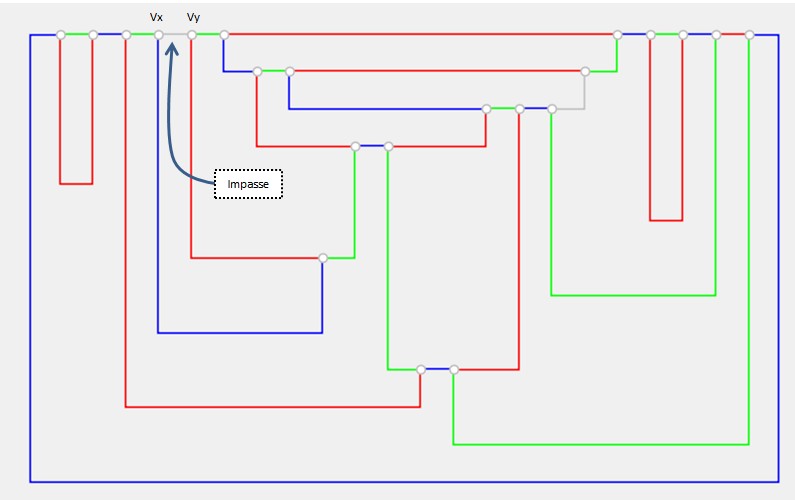
This is one of the map that I thought to be a counterexample, but it is not. Its signature is:
Since once completely colored, all chains are actually loops, when it comes to the last two impasses, if you solve one impasse also the other one gets solved!
For this example, no Kempe color switching exists along the main chain (b-r) = (1-2-3-4-5-6-7-8) that “divert” it, to make it end at a different vertex than vx. All other chains (*-g) along the main chain (b-r) involve vx or vy.
In this new version of the software you can manually color the edges of a map with three colors (RGB) and apply Kempe coloring switch on a Kempe edge chain (path or loop) (http://en.wikipedia.org/wiki/Kempe_chain).
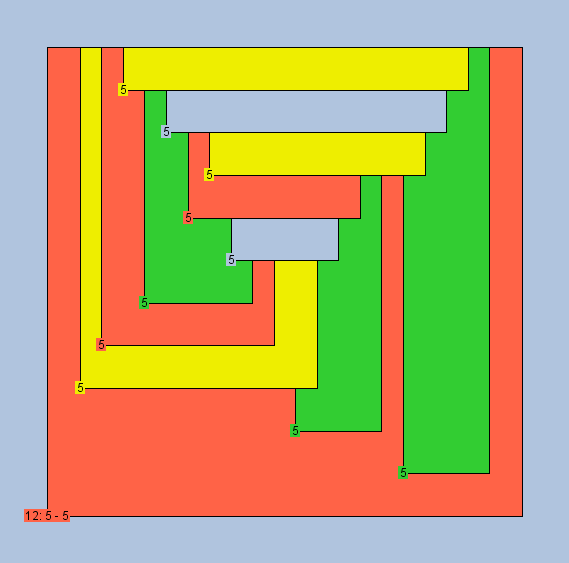
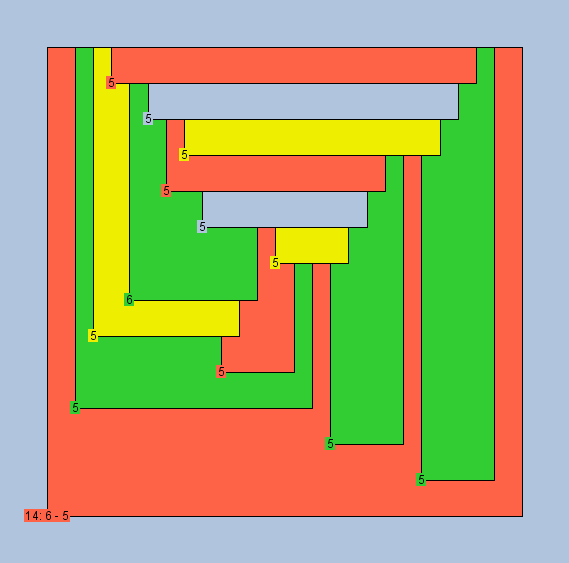
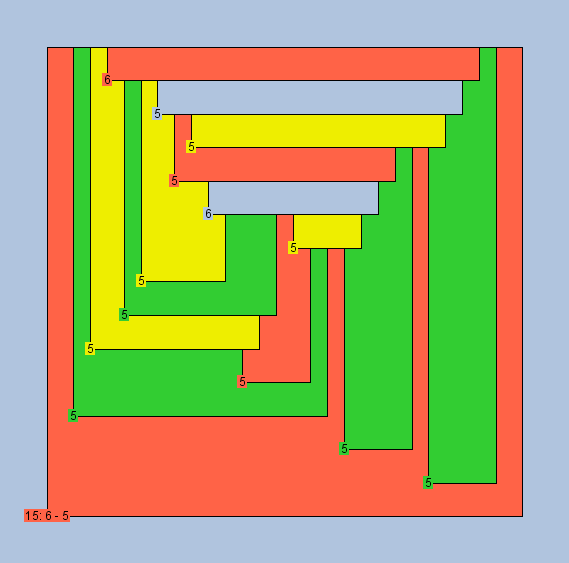
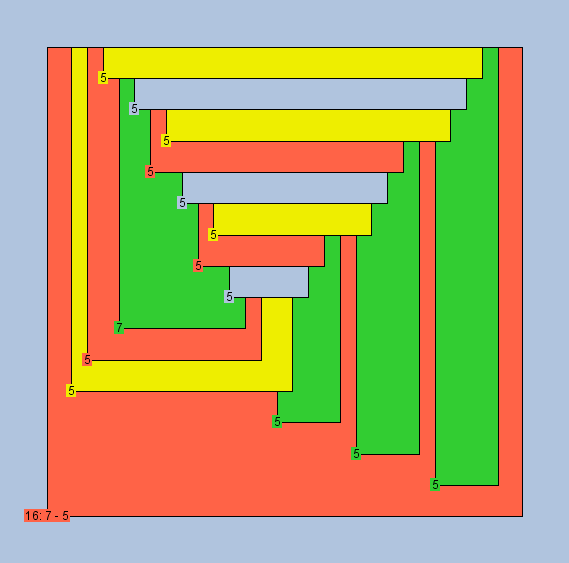
Analyzing all 3-regular graphs that have only faces with 5 edges or more (simplified), I empirically found (using a computer program) that many hypothetically possible graphs, that by Euler’s identity may exist (F5=12+F7+2F8+3F9+…), do not actually exist. Using a VF2 algorithm to filter out isomorphic maps, I also noticed that not so many graphs as I expected existed. And that one general category of graphs, that always represents a simplified 3-regular graph, is that of Fullerenes (with 12 faces F5 and an arbitrary number of F6). Here is a list of what I found, so far, for each class of graphs, from 12 faces to 20 faces (surrounding area included).
The question is: Since the computation of maps with 17, 18, 19, 20 faces (simplified and not containing isomorphic graphs) it is taking me very long time (days of CPU time on a PC), is this sequence already known?
Filter out duplicates. I finally found a java library to efficiently filter out all isomorphic graphs. It is a library part if the sspace project. Using it I will be able to test more complex simplified maps with lots of vertices … not risking to spend CPU time on duplicates
Finish the implementation of the Cahit algorithm to color the edges of a bridgeless cubic planar graph. I still need to well understand why Kempe’s chain color switching works using Cahit spiral chain method … especially when there is more than one spiral chain
Convert the swing application to javafx. This way I’ll be able to eliminate many third party dependencies: G, swixml, …