
⚠️ Warning: This timeline has been compiled using a combination of sources, including historical documents, books, and internet materials. Some descriptions adopt a narrative tone or show interpretations based on available records. While some effort has been made to ensure accuracy, this timeline is intended for personal use and contain speculative or debated details.
Sources:
- Website JSTOR
- Website MacTutor History of Mathematics archive
- Wikipedia page for the Four color theorem
- Book The Four-Color Theorem: History, Topological Foundations, and Idea of Proof by Rudolf Fritsch and Gerda Fritsch
- Book Four Colors Suffice: How the Map Problem Was Solved by Robin Wilson e Ian Stewart
Timeline of events about the theorem:
Early history (1852 – 1860s)
- 1852 – (England – London) Francis Guthrie told his brother Frederick Guthrie about some results he had been trying to prove about the coloring of maps and asked Frederick to submit to his professor Augustus De Morgan this problem.
- 1852 – (England – London) Frederick Guthrie asked his professor Augustus De Morgan if the problem that he showed to him was known.
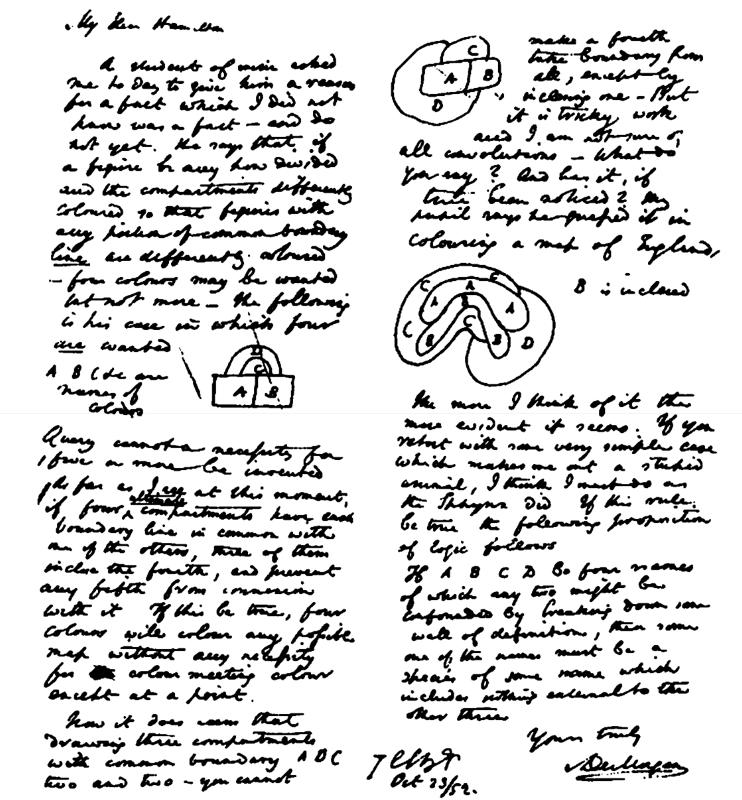
- 23 October 1852 – (England – London) Augustus De Morgan, fascinated by this problem, wrote the same day to William Rowan Hamilton in Dublin: “A student of mine asked me today to give him a reason for a fact which I did not know was a fact – and do not yet. …“. This letter marked the first recorded mention of the four color problem.
- 26 October 1852 – (Ireland – Dublin) William Rowan Hamilton replied after a few days (showing the efficiency of both himself and the postal service): “I am not likely to attempt your quaternion of colour very soon”, indicating his lack of interest in pursuing the problem.
- 09 December 1853 – (England – London) Augustus De Morgan wrote to his friend and former teacher, William Whewell, discussing the four color conjecture and describing an observation he regarded as a mathematical axiom. He noted that four regions, each adjoining the other three, required one of the regions to be enclosed by the others, a critical insight into the nature of the problem.
- 10 June 1854 – A brief mention of the four color problem appeared in the Athenaeum’s Miscellanea section, possibly authored by one of the Guthrie brothers or Francis Galton (because of the F.G. sign at the end of the text). This represents the earliest printed reference to the problem.
- 1860 – (England – London) Augustus De Morgan kept asking if anyone could find a solution to Francis Guthrie‘s problem and several mathematicians worked on it.
- 14 April 1860 – A review of Whewell’s book, The Philosophy of Discovery, in the Athenaeum outlined the four color problem and noted that it had been familiar to cartographers for some time.
- 1860 – Charles Sanders Peirce, an American mathematician and logician, may have become interested in the four color problem after reading about it in the Athenaeum. He later attempted to prove the conjecture and expanded his ideas to maps on other surfaces, such as the torus.
- 1861 – (South Africa – Cape Town) Francis Guthrie some years after he took A Bachelor of Arts (1850), Bachelor of Laws (1852), was called to the bar (1857) and moved to South Africa (1861), where he had a distinguished career becoming a professor of mathematics at the newly established college in Cape Town. He also contributed to botany and two plants were named after him: the Guthriea Capensis and the heather Erica Guthrie.
- 04 November 1869 – (England) The British interdisciplinary scientific journal Nature was first published this day.
- 1869 – Charles Sanders Peirce applied his “logic of relatives” to map coloring, using it as a test of his growing logical theories.
- June 1870 – Charles Sanders Peirce visited Augustus De Morgan in London, though there is no record of whether they discussed the four color problem.
- 13 June 1878 – (England – London) Arthur Cayley also learned of the problem from Augustus De Morgan and he posed a question to the London Mathematical Society asking if the Four Colour Conjecture had been solved, bringing renewed attention to the problem.
- 1878 – (United States – Baltimore) The American Journal of Mathematics (the oldest continuously published mathematical journal in the United States) was founded at the Johns Hopkins University by James Joseph Sylvester, an English-born mathematician.
- Apr 1879 – (England – London) Shortly afterward Arthur Cayley learned of the problem, he sent the “On the Colouring of Maps” (and here) paper to the Royal Geographical Society that published it. This paper explains where the difficulties lie in attempting to prove the Conjecture.
- 1879 – (United States) Charles Sanders Peirce was appointed as a lecturer in Logic in the Department of Mathematics at Johns Hopkins University and became, in that multidisciplinary conference, interested in the Four Colour Problem and also problems of knots and linkages studied by Alfred Bray Kempe. He then attempted to prove the conjecture and retained a lifelong interest in the problem.
- 17 July 1879 – (England – London) Alfred Bray Kempe, a London barrister and mathematician, announced in Nature (journal) that he had proof of the Four Colour Conjecture. His work was later published and received widespread acclaim at the time.
- 1879 – At Arthur Cayley‘s suggestion Alfred Bray Kempe submitted the Theorem to the American Journal of Mathematics where it was published (American Journal of Mathematics). William Edward Story read the paper before publication and made some simplifications. Alfred Bray Kempe received great acclaim for his proof.
- November 1879 – Charles Sanders Peirce reported on Alfred Bray Kempe‘s proof during a meeting of the Scientific Association of Johns Hopkins University, sharing his own enthusiasm for the conjecture.
- November 1879 – William Edward Story reported the proof to the Scientific Association of Johns Hopkins University and Charles Sanders Peirce, who was at the November meeting, spoke at the December meeting of the Association of his own work on the Four Colour Conjecture.
- December 1879 – Charles Sanders Peirce gave another talk about his ongoing research on the four color problem, showcasing the continuing interest in the topic.
- 1880 – Frederick Guthrie wrote a letter remembering it was his elder brother Francis that told him about the four color problem and asked to present the problem to Augustus De Morgan: “With my brother’s permission I submitted the theorem to Professor Augustus De Morgan, who expressed himself very pleased with it; accepted it as new; and, as I am informed by those who subsequently attended his classes, was in the habit of acknowledging whence he had got his information. If I remember rightly, the proof which my brother gave did not seem altogether satisfactory to himself; but I must refer to him those interested in the subject …”.
- 1880 – Alfred Bray Kempe published two improved versions of his proof, the second in 1880 aroused the interest of Peter Guthrie Tait, the Professor of Natural Philosophy at Edinburgh. Peter Guthrie Tait addressed the Royal Society of Edinburgh on the subject and published two papers on the (what we should now call) Four Colour Theorem. They contain some clever ideas and a number of basic errors.
- 1881 – Alfred Bray Kempe was elected a Fellow of the Royal Society and served as its treasurer for many years.
- 12 January 1885 – Heinrich Richard Baltzer gave a lecture to the Leipzig Scientific Society, where he incorrectly claimed that the four color theorem was proven through his work on the problem of five neighboring regions.
- 1890 – Percy John Heawood, a lecturer in Durham, England, published a paper titled Map Coloring Theorem. In it, he stated that his aim was rather destructive than constructive, as he intended to show a flaw in the then-apparently accepted proof. Despite this, Percy John Heawood established that every map could be colored with no more than five colors. The Four Color Theorem reverted to being the Four Color Conjecture. Percy John Heawood dedicated nearly 60 years of his life to the study of map coloring. He successfully investigated the number of colors required for maps on other surfaces and provided what is now known as the Percy John Heawood estimate, which determines the necessary number of colors in terms of the Euler characteristic of the surface.
- 1896 – Charles Jean Étienne Gustave Nicolas Baron de la Vallée Poussin also pointed out the error in Alfred Bray Kempe‘s paper, apparently unaware of Percy John Heawood‘s work.
- 1897 – Isabel Maddison wrote a note in the American Mathematical Monthly referencing Baltzer’s incorrect claims and Möbius’s earlier work on related problems. This led to further confusion about the origins of the four color problem.
- 1898 – Percy John Heawood made further contributions to the Four Colour Conjecture. This year he proved that if the number of edges around each region is divisible by 3 then the regions are 4-colourable. He then wrote many papers generalizing this result.
- 1904 – The search for unavoidable sets began in 1903 with the work of Ludwig August Paul Wernicke. An unavoidable set is a set of configurations such that every map that satisfies some necessary conditions for being a minimal non-4-colorable triangulation (such as having a minimum degree 5) must have at least one configuration from this set. Link to the article is here: https://link.springer.com/article/10.1007/BF01444968 or here
- 04 May 1912 – George David Birkhoff publishes the paper “A Determinant Formula for the Number of Ways of Coloring a Map“.
- 1912 – Alfred Bray Kempe was knighted and the same year he become the Chancellor of the Diocese of London. He received the honorary degree D.C.L. from the University of Durham.
- 1912 – Renewed interest in the USA was due to Oswald Veblen who published a paper on the Four Colour Conjecture generalizing Percy John Heawood‘s work. Further work by George David Birkhoff introduced the concept of reducibility on which most later works rested. A reducible configuration is an arrangement of countries that cannot occur in a minimal counterexample. If a map contains a reducible configuration, then the map can be reduced to a smaller map. This smaller map has the condition that if it can be colored with four colors, then the original map can also be. This implies that if the original map cannot be colored with four colors the smaller map can’t either and so the original map is not minimal.
- 1913 – George David Birkhoff introduces the concept of a “ring” around a country, which is a significant contribution to the understanding of the Four Color Theorem. His work “The Reducibility of Maps” reduces the problem to considering maps with a simple structure.
- 1922 – Philip Franklin published further examples of unavoidable sets and used George David Birkhoff‘s idea of reducibility to prove, among other results, that any map with ≤ 25 regions can be 4-coloured. The number of regions that resulted in a 4-colourable map was slowly increased. This wasn’t terribly edifying in itself, but Franklin’s method paved the way for the eventual solution by introducing the idea of a reducible configuration – See: The Four Color Problem.
- 1926 – Reynolds, using unavoidable sets, expanded Philip Franklin‘s work by demonstrating that maps with up to 27 regions could be four colored.
- 1937 – Hassler Whitney takes up the task to seek a proof. He suggests an algebraic approach to the problem and introduces the concept of “Kempe equivalence”, which would be fundamental for later proofs.
- 1940 – Henri Léon Lebesgue wrote a paper where he applied Euler’s formula and the counting formula for cubic maps to construct several new unavoidable sets..
- 1940 – Winn, using unavoidable sets, further extended the 4-colorable limit to maps with 35 regions, continuing the incremental progress on the conjecture.
- 1943 – Hugo Hadwiger formulates Hadwiger’s Conjecture, which is a far-reaching generalization of the Four Color Theorem, connecting it to graph theory
- 1950 – Heinrich Heesch, who had invented a clever method for proving that many configurations are reducible, said that he believed the four-colour theorem could be proved by finding an unavoidable set of reducible configurations. The only difficulty was to find one – and it wouldn’t be easy, because some rule-of-thumb calculations suggested that such a set would have to include about 10,000 configurations. With the computers then available, it would have taken about a century to deal with an unavoidable set of 10,000 configurations. Though modern computers can do the job in a few hours!
- 1954 – Richard Sprague expands Philip Franklin‘s result and proves the theorem for maps with 27 or fewer countries.
- 1965 – The mathematical historian Kenneth O. May observed, in an article on “The Origin of the Four-Color Conjecture“, that “the four color conjecture cannot claim either origin or application in cartography”, since cartographers never tried to minimize the number the colors used to color maps.
- 1969 – Heinrich Heesch introduced the method of discharging, paving the way for computational proofs. This consists of assigning to a vertex of degree i the charge 6 – i. Now from Euler’s formula, we can deduce that the sum of the charges over all the vertices must be 12. A given set S of configurations can be proved unavoidable if for a triangulation T which does not contain a configuration in S we can redistribute the charges (without changing the total charge) so that no vertex ends up with a positive charge. Heinrich Heesch thought that the Four Colour Conjecture could be solved by considering a set of around 8900 configurations. There were difficulties with his approach since some of his configurations had a boundary of up to 18 edges and could not be tested for reducibility. The tests for reducibility used Alfred Bray Kempe chain arguments but some configurations had obstacles to preventing reduction.
- 1970 – Øystein Ore and Stemple advanced the boundary further, showing that maps with up to 39 regions could be four colored, using unavoidable sets.
- 1971 – Harold Scott MacDonald Coxeter corrected a historical misconception, clarifying that Francis Guthrie, not Möbius, originated the four color problem. Since then, Francis Guthrie has been universally recognized as its true creator. His paper “The Mathematics of Map Coloring” was published in the Leonardo journal
- 1972 – Thomas L. Saaty published in The American Mathematical Monthly his “Thirteen Colorful Variations on Guthrie’s Four-Color Conjecture” paper, for which he received the Lester R. Ford Award from the Mathematical Association of America for expository excellence
- 01 April 1975 – April Fool’s joke. Martin Gardner published in Scientific American “Six sensational discoveries that somehow or another have escaped public attention” with a counterexample of the four color theorem “… last November, William McGregor, a graph theorist of Wappingers Falls, N.Y., constructed a map of 110 regions that cannot be colored with fewer than five colors”.
- July 1975 – April Fool’s joke map solved. The Journal reported that they received more than a thousand letters and hundreds of drawings with the proper coloring of the map.
- 1976 – Mayer, using unavoidable sets, to 95.
- 1976 – Kenneth Ira Appel and Wolfgang Haken used a computer to check 1936 cases, giving the first and final proof! The proof was achieved by Kenneth Ira Appel and Wolfgang Haken, basing their methods on reducibility using Alfred Bray Kempe chains. They carried through the ideas of Heinrich Heesch and eventually, they constructed an unavoidable set with around 1500 configurations. They managed to keep the boundary ring size down to ≤ 14 making computations easier than for the Heinrich Heesch case. Kenneth Ira Appel and Wolfgang Haken used 1200 hours of computer time to work through the details of the final proof. Koch assisted Kenneth Ira Appel and Wolfgang Haken with the computer calculations.
After the proof:
- 1977 – Details of the Kenneth Ira Appel and Wolfgang Haken proof appeared in two article.
- 1996 – A new simplified version of the proof is found. Robertson, Sanders, Seymour and Thomas used a computer to check 633 cases instead of 1936 cases.
- 2008 – George Gonthier and Benjamin Werner, proved four colour theorem using Coq. Unlike the programs used by Kenneth Ira Appel and Wolfgang Haken, Coq automatically generates proof on the basis of the algorithm that has been selected. So we have a proof of which 0.2% was done by a human being (that matters and must be gotten right) and the other 99.8% by a machine (since Coq considered robust and reliable). The shortest known proof of the four colour theorem today still has over 600 cases and is a proof by exhaustion.
- Now – Short and human-readable proof is still wanted.
TMP TMP TMP – to be merged
- https://mathshistory.st-andrews.ac.uk/Biographies/Heawood/ – Percy John Heawood wrote on the four colour problem again in 1897, 1932, 1936, 1943, 1944 and his final paper on the topic in 1949 was given the same title Map colour theorems as his first paper
- 1860s – Charles Sanders Peirce presented an attempt to prove the four color theorem at Harvard University, extending it to other surfaces like a torus, where maps can require more colors.
 Four Color Theorem
None of the work by Appel or Haken is correct if they use any property less then five parts, like 3or 4 , I have this proof .
LikeLike
What do yo mean when you say “if they use any property less then five parts”? To my knowledge, Appel and Haken’s proof of the Four Color Theorem does not rely on any specific restriction. Their proof relied on the concept of reducible configurations, which are patterns that can be reduced to smaller configurations until a base case is reached.
LikeLike
I am 91 years old , when they came out with there proof I had called them and asked them this question , did you cover all possible configurations ? There answer was no . I do not know witch one that I talked to. In mathematics they say that adding and multiplying are the same . However , when we add two ones we have two , then when we multiply two ones we obtain one , that has a bearing on this problem , as I can show .
LikeLike
Have you ever published or documented your observations?
LikeLike
I am 91 years old , I called them when they made there claim, this is what i asked them, did you cover all possible configurations ? they said no. It is not easy to make all properties with only 5 or more neighbors to produce a five color map.
LikeLike
Hi thanks for postiing this
LikeLike
When was this article written?
LikeLike
It has been modified many times. I did change some parts few months ago
LikeLike