T1 was already known


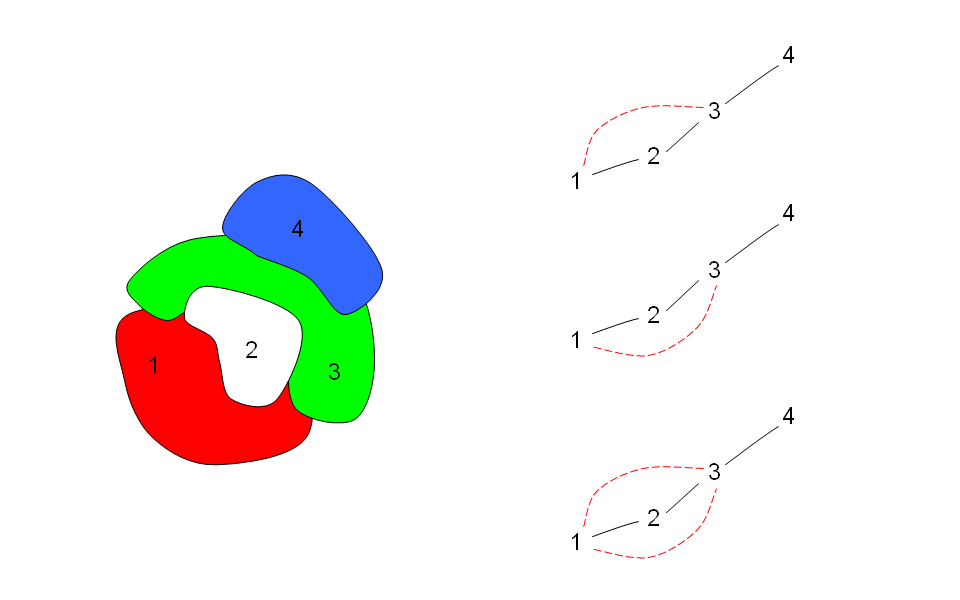
The theorem I proved in T1 was already known. It was found by Kempe back in 1879 in terms of graph theory (see http://en.wikipedia.org/wiki/Four_color_theorem: “Kempe also showed correctly that G can have no vertex of degree 4″). Only 132 years later … not bad.

People from http://cstheory.stackexchange.com helped me on this (to find that it was already known). See here: http://cstheory.stackexchange.com/questions/5822.

I still think my proof it is of some value, since it is not expressed in terms of graph theory (of the dual graph derived from the map).
Four color theorem: music is on


When coloring maps using the Java application each color can play a different instruments with different parameters.

Download the application and play it yourself: https://github.com/stefanutti/maps-coloring-java.

Or turn on the speakers and watch this video:

Four color theorem: slow motion maps


Here is a video that shows the nature of rectangular and circular maps.

All maps concerning the four color theorem (“regular maps” | “planar graphs without loops”) can be topologically transformed into rectangular and circular maps.

Four color theorem: which one is the correct graph?


Wikipedia: “In graph-theoretic terminology, the four-color theorem states that the vertices of every planar graph can be colored with at most four colors so that no two adjacent vertices receive the same color, or for short, every planar graph is four-colorable.”

But exactly which kind of planar graphs have to be considered?:

  • Without loops
  • What about multiple edges? Why are these often excluded?

Four color theorem: potential criminal


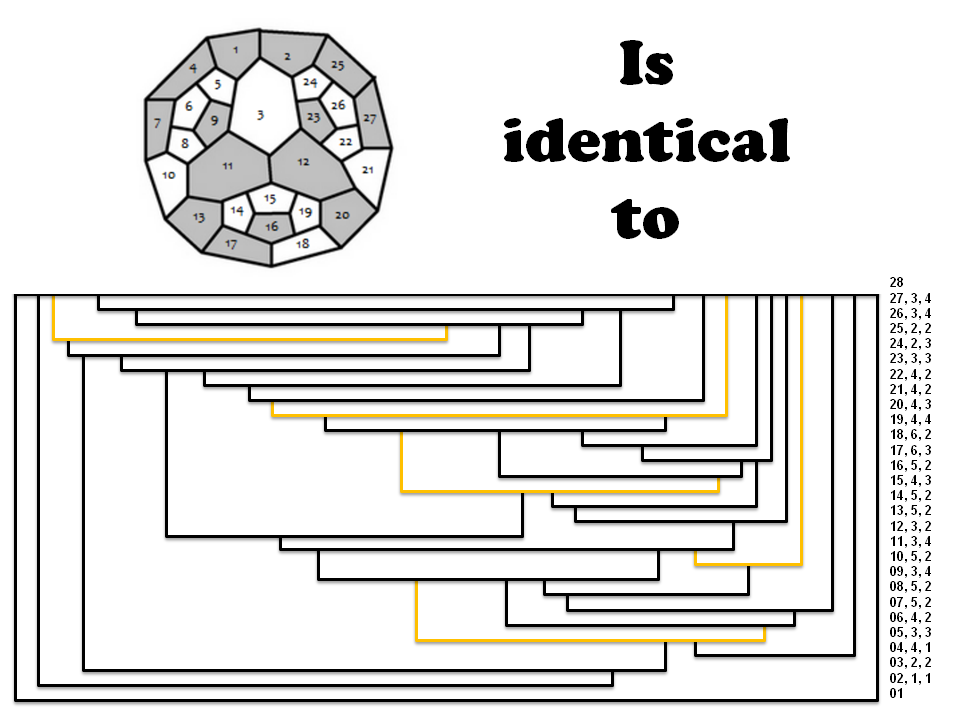
Here is the tranformation of a potential criminal map into a rectangular map. All regular maps can be topologically trasformed into rectangular or circular maps. See the theorem in T2.

Faces 5, 10, 15, 20, 25 are marked with a different color to simplify the reading of the map.

The computerized and colored version can be found here: Conversion of famous maps.

The string that represents this map and that can be used with the Java application to recreate this map is:

1b+, 2b+, 25b+, 27b+, 26b-, 24b-, 3b-, 23b-, 12b-, 22b-, 21b-, 20b-, 19b-, 15b-, 16b-, 18b-, 17b-, 11b-, 9b-, 5b-, 6b-, 8b-, 7b-, 2e-, 3e-, 4b-, 5e-, 6e-, 9e-, 10b-, 8e-, 12e-, 14b-, 13b-, 11e-, 15e-, 16e-, 14e-, 19e-, 25e-, 24e-, 23e-, 26e-, 22e-, 27e+, 21e+, 20e+, 18e+, 17e+, 13e+, 10e+, 7e+, 4e+, 1e+

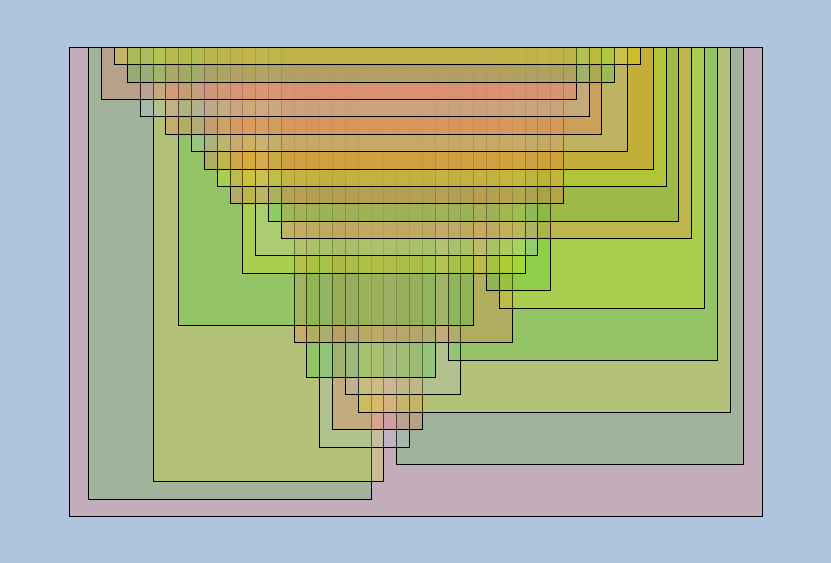
Here is a picture of this map with transparency set to 15%:

Tutte’s map


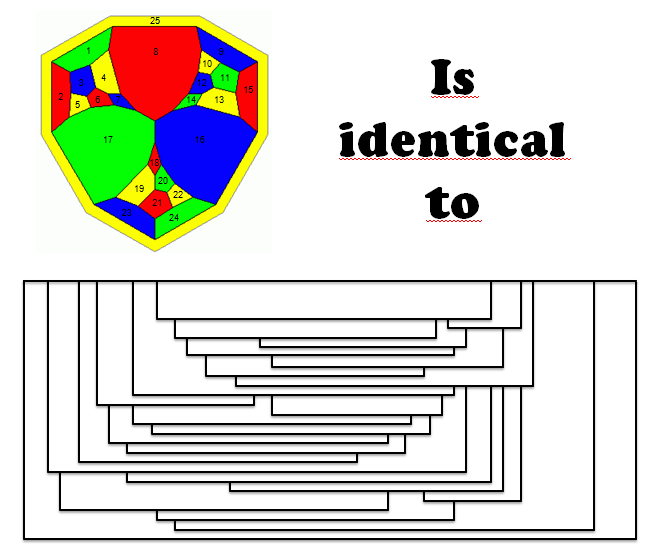
I corrected a mistake on Tutte’s map conversion. This one is the fixed version. Face number 25 surrounding all the other faces on the original map, is the ocean of the rectangular and circular maps.

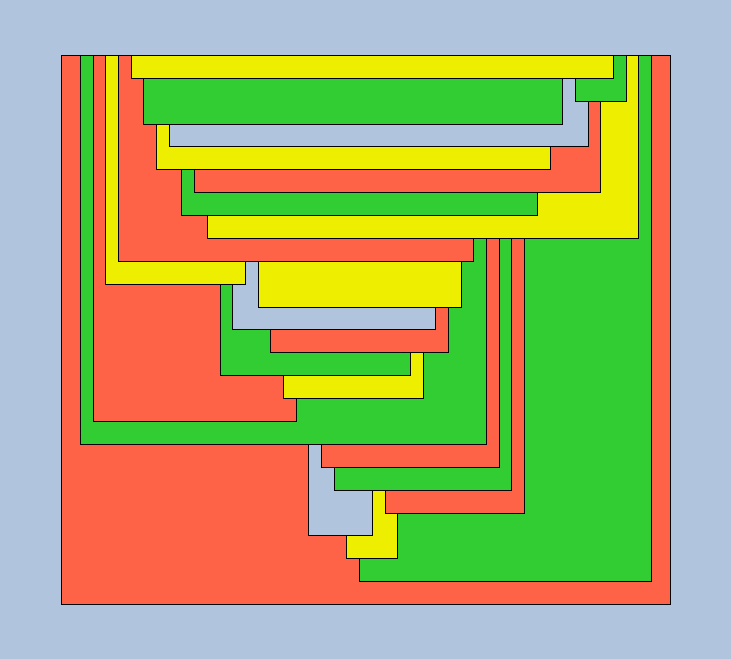
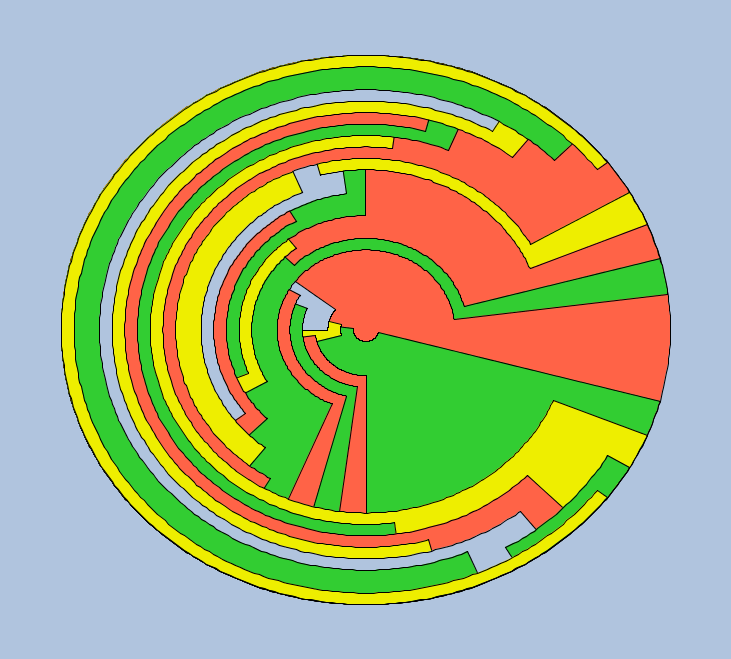
Same map converted into rectangular and circular (using different colors):


Tutte’s map conversion (1/2)


CORRECTED!

All regular maps can be topologically transformed into rectangular of circular maps (see T2).

This is the conversion of Tutte’s map, made by hand, into a rectangular map. The colored and computerized version will follow.

These conversion are done just for fun and have not theoretical interest. The theorem in T2 proves that all regular maps (basically all maps of interest to the four color theorem) can be converted into circular of rectangular maps.

Tutte’s map on the left and the map made of rectangles right below it, are exacly the same map. Face number 25 correspond to the surrounding area (the ocean) of the rectangular map.