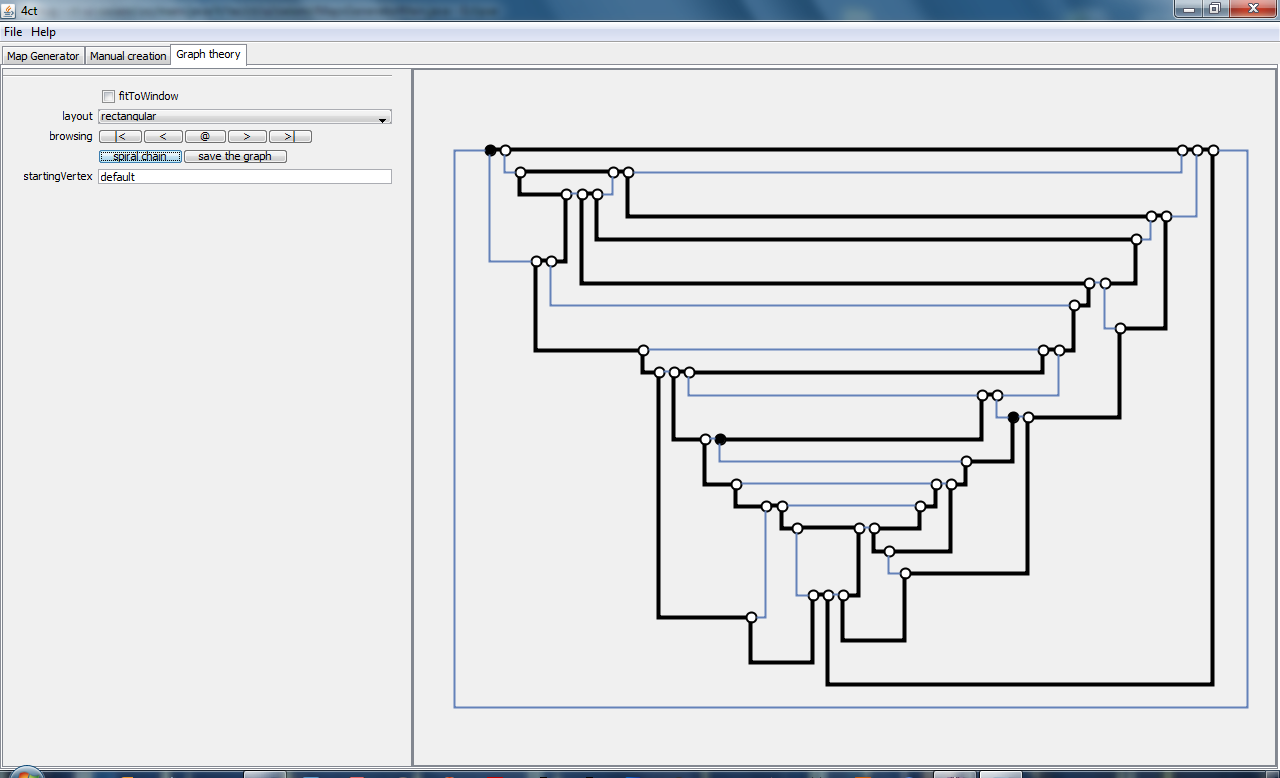
Four color theorem: Cahit spiral chains (step two)


Now the application is able to find all spiral chains of a graph.

I still need to:

  • Implement the Cahit coloring algorithm using the spiral chains
  • Add some additional features to the Java application
    • Modify the settings to color the edges
    • Manual selection of the starting vertex
    • Manual coloring of the Edges

The application can be downloaded from the github site.

About the Cahit coloring algorithm there are some things that I need to undestrand before implementing the Java code.

Four color theorem: Cahit spiral chains


Hi,

I’ve found some time to implement the first version of Cahit Spiral Chains algorithm.

I still need to:

  • Find all spiral chains of a given graph and not only one (changing the starting point)
  • I need to implement the concept of “nearest unused vertex to the last vertex of the last spiral chain”. This is needed to find the starting point of the next spiral <– DONE

Here is the video on youtube:

Four color theorem: deep analysis of a map


I would like to implement a brute force algorithm to search ALL the different colorings of a map.

Here is the question on: math.stackexchange.com

In terms of graph theory I’d like to find all four colorings of the vertices of a planar graph (the dual representing the map).

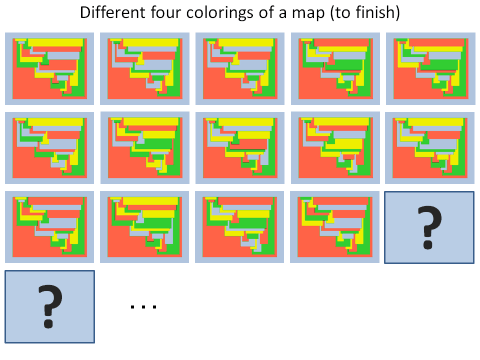
I’m interested in maps in which each face is an opaque rectangle layered on all previous rectangles, overlapping partially. Each consecutive rectangle starts at a consecutive y coordinate. The next picture should better clarify what I mean.

The faces are numbered from 1 to n

  • face 1 is the face on the bottom of the pile
  • face (n-1) is the face at the top
  • face n is the infinite face surrounding all others

For the meaning of different colorings you can refer to this question: mathoverflow.net

I was thinking to pre-set the colors of faces and use a classical brute force algorithm to get four coloring of the map. I already implemented the brute force algorithm to find the proper coloring of a map and I can also force the color of faces to find particolar colorings.

The problem is that I’m not coming up with an algorithm to do it automatically and to be sure to find ALL colorings.

To see what I have so far, you can watch this video on youtube:

!

What I know is that:

  • Since the colors of three neighbors faces can be arbitrary, face number n, face number 1 and the face touching both (face n and face 1), can have these fixed colors: blue, red, green

Manually I found these colorings:

Four color theorem: java application update


I new version of the java application is available with these new features:

  • Save .png images and restore maps from the image itself (using metadata within it)
  • Force coloring of faces to find different coloring of the same map
  • Faster coloring

Download it from here:

Video will be added soon on the youtube channel:

Four color theorem: hello world


These translations have been taken from wikipedia, starting from http://en.wikipedia.org/wiki/Four_color_theorem. I was just curious to see if people search for the “four color theorem” only in english.

Teorema dei quattro colori
Problém čtyř barev
Firfarveproblemet
Vier-Farben-Satz
قضیه چهاررنگ
Théorème des quatre couleurs
Teorema das catro cores
משפט ארבעת הצבעים
Teorema de los cuatro colores
Dört renk teoremi
Kvarkolormapa teoremo
四色定理
ทฤษฎีบทสี่สี
Vierkleurenstelling
Négyszín-tétel
4색정리
चार रंग की प्रमेय
Problemo di quar kolori
Keturių spalvų teorema
Teorema celor patru culori
Проблема четырёх красок

Four color theorem: other representations of maps


Here are some new representation of graphs:

Thanks to:

Four color theorem: representations of maps


For the scope of the four color problem and without lack of generality, maps can be represented in different ways. This is generally done to have a different perspective on the problem.

For example, the graph-theoretic representation of maps has become so common and important that generally the four color problem is stated and analyzed directly in terms of graph theory: http://en.wikipedia.org/wiki/Four_color_theorem.

I am trying to collect other representations that may in some way help to get a different point of view on the problem. If you know one of these representations that is not listed and wish to share, report it here. If you also have a web reference that explains or shows the representation, it would be great.

The representations have to be general and applicable to all maps with the simplification that only regular maps (no exclaves or enclaves, 3 edges meeting at each vertex, etc.) can be considered.

These are some classic representations:

  • Natural: As a 3-regular planar graph (boundaries = edges)
  • Canonical: As the dual graph of the “natural” representation (region = vertex, neighbors = edges)
  • As a straight line drawing graph (Fáry’s theorem)
  • As a graph with vertices arranged on a grid
  • As a rectilinear cartogram

Plus, I found these:

  • As a circular map
  • As a rectangular map
  • As clefs (derived from rectangular maps)
  • As pipes map (derived from the clefs representation)

New representations (answers from mathoverflow):

Here is an example of some of these representations for the original map shown:

See next post for other representations.

Counting maps


I’ve posted this question on mathoverflow.

Is there a formula to count how many different topological regular maps can be created with n faces (on a sphere)?

  • For “regular” I intend maps in which the boundaries form a 3-regular planar graph
  • For “different” I intend maps that cannot be topologically transformed one into another (faces have to be considered unnamed)

I’ve been looking for a formula, but it is too difficult for me. Maybe it has a simple solution but I don’t see it.

This was my best guess, but I already know that it is not correct because full of symmetries, as it can be verified manually.

General formula:

2\sum _{s_{(f-3)}=2f-5}^{2f-5+2} \text{...}\sum _{s_3=7}^{s_4} \sum _{s_2=5}^{s_3} \sum _{s_1=3}^{s_2} s_1\left(s_1-1\right)\left(s_2-3\right)\left(s_3-5\right)\text{...}\left(s_{(f-3)}-((2f-5)-2)\right)

4 faces = 2\sum _{s_1=3}^5 s_1\left(s_1-1\right)
5 faces = 2\sum _{s_2=5}^7 \sum _{s_1=3}^{s_2} s_1\left(s_1-1\right)\left(s_2-3\right)

Here are the first results that can be found manually (excluding simmetrical maps):

  • 2 faces = 0 possible regular map (an island and the ocean) (not to be counted, because not regular)
  • 3 faces = 1 possible regular map (an island with two regions and the ocean) (two islands and the ocean wouldn’t be regular)
  • 4 faces = 3 possible regular maps (can be verified adding a face from the previous map)
  • 5 faces = 16 possible regular maps (with homeomorphics eliminated)

These are all maps up to 5 faces:

Four color theorem: recap


Recap (some facts about maps and coloring):

  • All regular maps (3-regular planar graphs) can be topologically transformed (represented) as circular or rectangular maps
  • In searching for a solution of the four color problem, it is possible to exclude maps with faces that have less then five neighbours
  • Simplified maps (no faces with less than five neighbours) of 13 faces do not exist!
  • The nunber of proper colorings (not considering permulations of colors) can be count using the “Chromatic polynomial” and dividing the result by 4! (factorial that counts the permutations). Chromatic polynomial is only known for few types of graphs (Triangle K3, Complete graph Kn, Petersen graph, …)
  • Dual graphs derived from maps can be arranged with vertices positioned on a grid (see “Rectangular grid drawings of plane graphs” by Md. Saidur Rahman, Shin-ichi Nakano, Takao Nishizeki)

To implement on the Java application (https://github.com/stefanutti/maps-coloring-java):

Are these different colorings?


UPDATE (18/Apr/2011)

The nunber of proper colorings (not considering permutations of colors) can be count using the “Chromatic polynomial” and dividing the result by 4! (factorial that counts the permutations). But, the chromatic polynomial is only known for few types of graphs (Triangle K3, Complete graph Kn, Petersen graph, …). I haven’t found papers on this problem. Highly propably, since the difficulty to find the Chromatic polynomial of complex graphs, there cannot be a direct formula to calculate how many different colorings exist.

I’ve posted this question here on mathoverflow.

END UPDATE

Take a look at these three graphs:
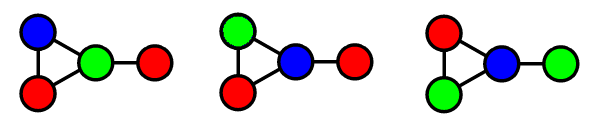
Are these really different colorings?

Before to dismiss this, do the following on the first graph:

  • Change Blue to Yellow (Blue was just an arbitrary color among infinite others)
  • Change Green to Blue
  • Change Yellow to Green

Now you have the second graph. Continue with this:

  • Change Green to Yellow
  • Change Red to Green
  • Change Yellow to Red

Now you have the third graph. Since the arbitrary nature of the choice of colors, the first graph could have been colored as the third one since the beginning.

The same result, can be obtained by changing all three colors of the first graph to three other colors. If applying the same method to the third graph, you can get the same configuration for the two graphs, it means that they can be considered, for some areas of investigation, as the same configuration.

There are more complex cases in which swapping colors won’t help to get from one coloring to the other.

In the following picture taken from http://en.wikipedia.org/wiki/Graph_coloring, the graphs named (A) and (B) are the only ones that cannot be converted into one another by swapping colors.
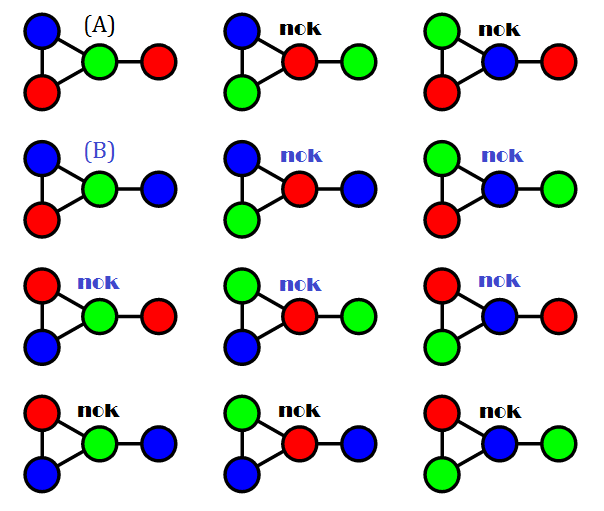
In particular I’m interested in regular maps, excluding all maps that can be colored with 2 or 3 colors. For what I need to analyze, maps have to be regarded as differently colored, if the same coloring cannot be obtained by subsequent exchanges of colors.

In other words, for example, once a map has been properly colored, I don’t want to count all other configurations that derive from subsequent exchanges of colors.

Since the arbitrary nature of choosing colors, these derived configurations are equivalent (for what I’m analyzing) to the first one, since they could have been obtained just choosing different colors in the first place. Instead, there are colorings that differ in such a way that exchanging colors won’t help to transform one configuration into the other.

My question is: how many “different” colorings (in the meaning I explained) exist for a given map?

I’ve only found an article on http://en.wikipedia.org/wiki/Graph_coloring that count all possible colorings including swaps.

Is there a paper that can help me on this?