Four color theorem: almost there?


Here there are some results that came out from the study of Kempe chains/cycles (of edges) in Tait coloring of a 3-regular planar graph.

Next is shown an image with a summary of the ideas behind this approach. I didn’t have the time to re-create this into computerized images. I will do it later. Soon will follow the F5 case for the part I’ve been experimenting with success (sub-condition where the two edges lies on two different Kempe-cycle – see below).

kempe-half-cycle-swapping-method

Here is the F4 case shown a little better:

kempe-half-cycle-swapping-method-F4

And here some deeper details of these ideas.

Theorem: In a well edge-colored (Tait coloring) 3-regular planar graph all Kempe chains are cycles

  • This can be easily proved showing that, once colored, the edges of any vertex use all the three colors (for example R, G, B), so if you are following the path of a Kempe chain, as for example an (G, B)-Kempe chain, the chain itself cannot end to a vertex, because one of the other two edges continues the kempe chain, unless that edge was exactly the first edge you started following the path of the chain … making it a Kempe cycle, as for example the (G, B)-Kempe cycle of this picture
  • Note: This theorem, in this form, is valid if the graph is already well colored (three colors). Consider that to say that the edges of a graph can be well colored (using three colors) is as difficult to prove as the four color theorem for the faces of a map. Never the less this result can be used to search a short proof of the four color theorem, even if it depends on the long proof ;-). Or (better) this result can be used without this dipendency on the long version, immerged in the reduction method when restoring the edges one at a time. As long as you solve the N+1 case (restore of F2, F3, F4, F5), starting from the map with only two faces (the island and the ocean surrounding it) the theorem is true
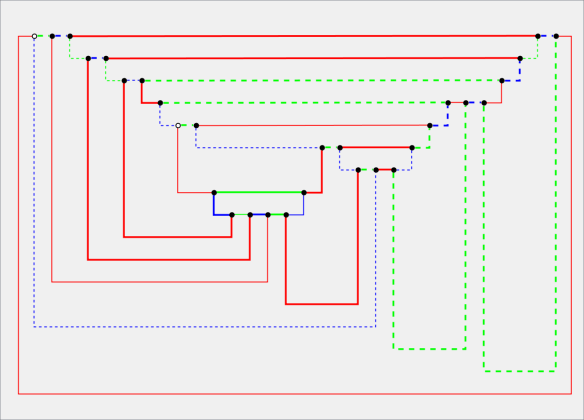
kempe-cycle

Picture-01: All Kempe-chains are Kempe-cycles

Steps and results toward a short proof of the 4ct:

  • Simplify the map removing one edge from one of the faces with 2, 3, 4 or 5 edges. Repeat this procedure until the map will have just one country left. This simplification procedure can be always done because the set { F2, F3, F4, F5 } represents an unavoidable set, so every 3-regular planar graphs has to have at least one face of the type included in the set
    • The procedure, for a simple map, is shown in the previous post: here
    • The idea is similar to the “patching” method used by Kempe, in which a “patch” with the same shape but a bit larger of a face (F2, F3, F4 or F5), was put over the face to shrink it down to a point. You can read the original paper here: On the Geographical Problem of the Four Colours
  • In reverse order, restore the edges that were removed, one at a time. Each time an edge is restore, we can face one of these conditions:
    • the edge restores an F2 – Note: particular and trivial case (see next point)
    • the edge restores an F3 – Note: trivial case
    • the edge restores an F4 – Note: Easy to handle
    • the edge restores an F5
  • F2 as a trivial case
    • When the restored edge reestablish an F2 face, it means the vertices of the resored edge, touch a single edge and so you have a spare color to use to solve this case (HAPPY END)
  • For all previous conditions (F2 can be seen as a particular case) there are two main possibile sub-conditions
    • CONDITION-1: The two edges touched by the restored edge are on a common Kempe cycle
      • If the two edges belong to a Kempe-cycle, the solution is easy. Apply a Kempe-chain color swapping to half (one of the two parts of the cycle being “cut” by the restored edge) of the cycle to solve this case (HAPPY END)
      • Consider that in case of the restored face is an F3, this is always the case, since the two edges touch each other. So also F3 can be regarded as a particular case
    • CONDITION-2: The two edges touched by the restored edge are NOT on a common Kempe cycle, but on distinct cycles … of course with no common edges
      • TBF: This is easy to handle for F4 and of course for F2 and F3 that are particular cases. For the F5 case I’m trying to prove that all cases can be reconducted to CONDITION-1

If this Example-02 the restored edge (in black) reestablish an F5 face. Both the edges (Green = on the left, Red = on the right) do non lie on the same (G-R)-cycle (CONDITION-2). Similar examples can be created when the two touched edges have the same color. In that case you can consider two different Kempe-chain ((R-x)-chain if the edges are colored Red) or you can easily reconduct that case to the one with different colors

kempe-cycle-F5-both-edges-not-on-cycles

Example-02: Example of restoring an F5

Now the diffucult part of the proof about the F5 case where the two edges do not lie on the same Kempe-cycle.

How can I reconduct a CONDITION-2 (edges NON on the same Kempe-cycle) to a CONDITION-1 (edges on the same Kempe-cycle)?
Four color theorem: back to the basics


Finally I bought two books about the four color theorem: “Four Colors Suffice: How the Map Problem Was Solved” by Robin Wilson e Ian Stewart; and the “The Four-Color Theorem: History, Topological Foundations, and Idea of Proof” by Rudolf Fritsch and Gerda Fritsch.

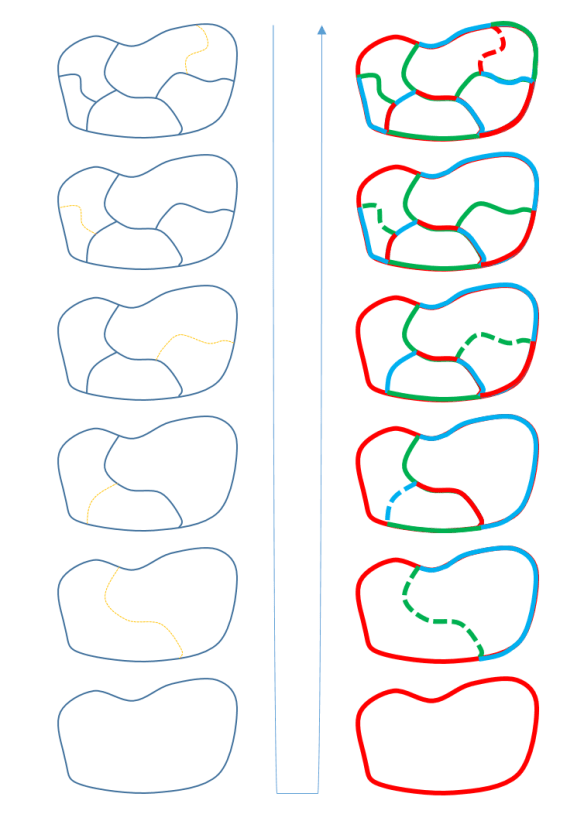
I am currently reading the first one, and I want to revisit the fundamentals by using the method Kempe employed when he believed he had solved the problem.

With these differences: I will approach it removing one edge at a time from F2, F3, F4, or F5 faces (unavoidable set) to reduce the map to two faces (including the ocean). Afterward, I will restore the edges in reverse order, consistently working with 3-regular planar graphs. Instead of applying Kempe’s chain color switching solely to the faces, I will consider Tait coloring of the edges and apply Kempe’s chain color switching to the edges.

Follow the arrow to visualize the steps:

kempe-reduction-and-kempe's-chain-v3.png

Four color theorem: experimenting impasses (as in life)


I still think a solution may be found in Kempe chain color swapping … for maps without F2, F3 and F4 faces (or even without this restriction).

Or at least I want to try.

kempe-chain-impasse-v2

How you can solve the impasses (To be finished):

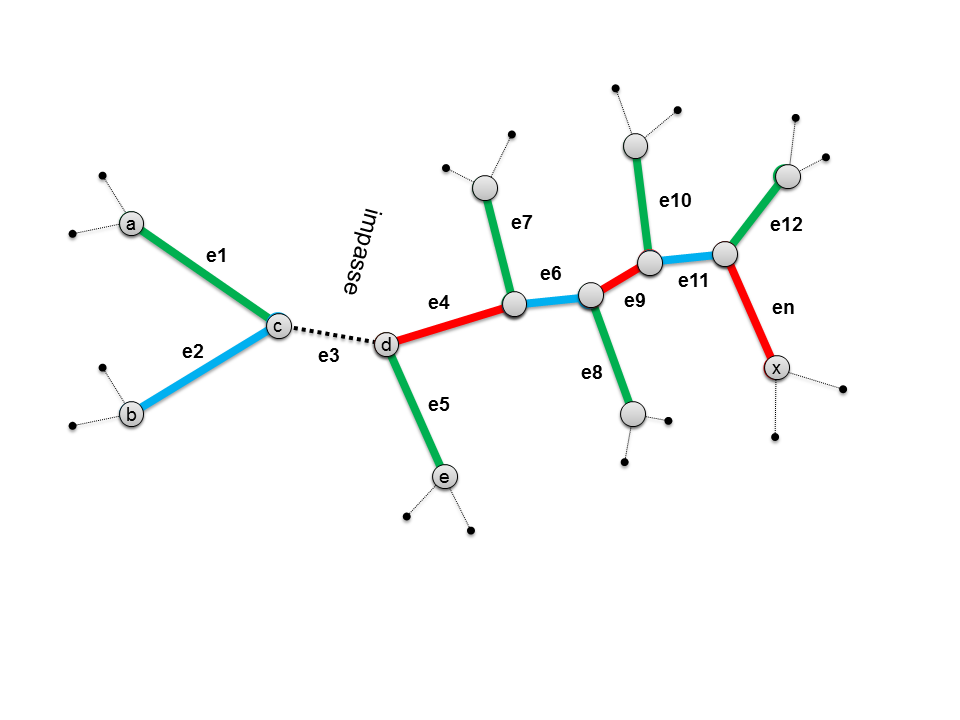
To explain the possible cases, without lack of generality, I can assume to start with these colors: e1=red, e2=green, e3=blue, e4=red. e4 may also be colored in green, the reasoning will not change much.

  1. If e3 and e4 are not colored … there is no impasse → OK
  2. If e3 is the same color ex should be (blu in the example) and e4 is non colored
    1. If one of the two possible chains starting from e3: (b, r)-chain or (b, g)-chain does not end at e1 or e2
      1. Use it to swap the color of e3 and solve the impasse → OK
    2. If both end at e1 or e2
      1. Try to deroute one of the two chains, using another kempe chain color swapping along the way, to fall into one the the solvable cases (2.A)
        1. If the derouted original chain does not longer end at e1 or e2, then apply the original kempe chain color swapping and solve the impasse → OK
        2. If deroute does not work
          1. … TBV: It seems that swapping colors around solve all type of impasses
  3. If e3 is the same color ex should be, and e4 is also colored
    1. In this case the chain (…-e3e4-…) = (b, r)-chain would simply swap the colors of e3 and e4 and therefore will not solve the impasse. It is better to use the other (b, g)-chain, starting from e3
      1. If this chain does not end at e2 (e1 is not a possible end because the chain is blue and green), use it to swap the color of e3 and solve the impasse → OK
      2. If it ends at e2
        1. Try to deroute the chain, using another kempe chain color swapping along the way, to fall into one the the solvable cases
        2. If deroute does not work
          1. TBV: It seems that swapping colors around solve all type of impasses

A deroute of a chain appears as in the next picture. Consider that deroutes may not work because Chain-B color swapping may change one or more of the three edges e1, e2, e4, and after appying the Chain-B swap, the chain starting with a3, may still end to one to e1, e2, e4. See this post for a real example: here.

kempe-chain-deroute-v2

About swaps of a partially colored map, I’ve asked a question on mathoverflow … here.

Maybe I was wrong when, in the motivation of the question (mathoverflow), I said that “I found many examples in which Kempe chain color swapping does not work for maps with faces of type F2, F3, F4, but I did not find an example of maps with only F5 or higher“. It seems to be possible also for maps with F2, F3, F4.

I’ll continue to search for counterexample but, for what I’ve seen so far (I tryed about 50 maps) it has been always possible to solve impasses, only proceeding by swapping colors.

This is one of the map that I thought to be a counterexample, but it is not. Its signature is:

  • 1b+, 9b+, 9e+, 3b+, 5b+, 7b+, 12b+, 10b-, 11b-, 5e-, 7e-, 4b-, 3e-, 2b-, 10e-, 4e-, 6b-, 11e-, 12e+, 8b+, 8e+, 6e+, 2e+, 1e+

impasse-in-map-not-simplified

Something else to check:

  • Since once completely colored, all chains are actually loops, when it comes to the last two impasses, if you solve one impasse also the other one gets solved!

Four color theorem: Cahit spiral chains and Tait coloring


I was experimenting impasses and I found this about spiral chains:

  • Consider all possible maps less than or equal to 18 faces (including the ocean)
  • Do not consider duplicates (isomophic maps)
  • There is still a very large number of possible such maps
  • Remove all maps that have faces with 2, 3, 4 edges
  • The number of maps reduces to 22 maps only
  • All these 22 maps have only one spiral chain
  • To get the Tait coloring, required me only one Kempe chain color swapping per map
  • Actually I complitely colored the spiral (the backbone) with two colors and then I finished the other edges and at the end I worked on impasses
  • Next, I’ll try the algorithm described here:

Four color theorem: counterexample to the hypothesis I was verifying :-(


Bad news … to me!

This example it is a counterexample to the hypothesis I was trying to verify!

Map signature: 1b+, 4b+, 6b+, 15b+, 7b-, 14b-, 8b-, 12b-, 13b-, 11b-, 9b-, 8e-, 7e-, 5b-, 6e-, 9e-, 10b-, 5e-, 4e-, 3b-, 10e-, 11e-, 12e-, 3e-, 2b-, 13e-, 14e-, 15e+, 2e+, 1e+

😦

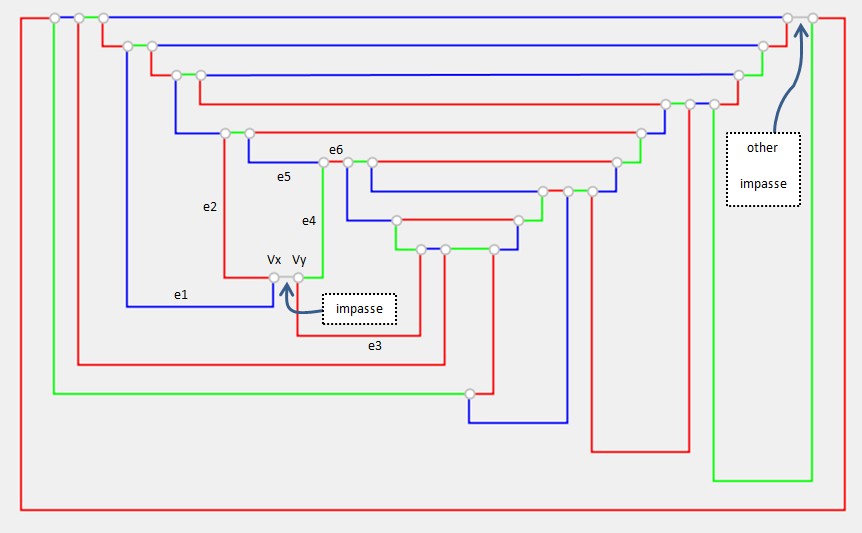
For this example, no Kempe color switching exists along the main chain (b-r) = (1-2-3-4-5-6-7-8) that “divert” it, to make it end at a different vertex than vx. All other chains (*-g) along the main chain (b-r) involve vx or vy.

hypothesis-counterexample-v2

Four color theorem: 3-edge coloring, impasse and Kempe chain color swapping


It is known that for regular maps, “3-edge coloring” is equivalent to finding a proper “four coloring” of the faces of a map.

This post is about coloring impasses, fallacious Kempe chain color swapping (not solving the impasse) and an hypothesis I’d like to verify.

FIRST: What is an impasse

kempe-chain-impasse-v2

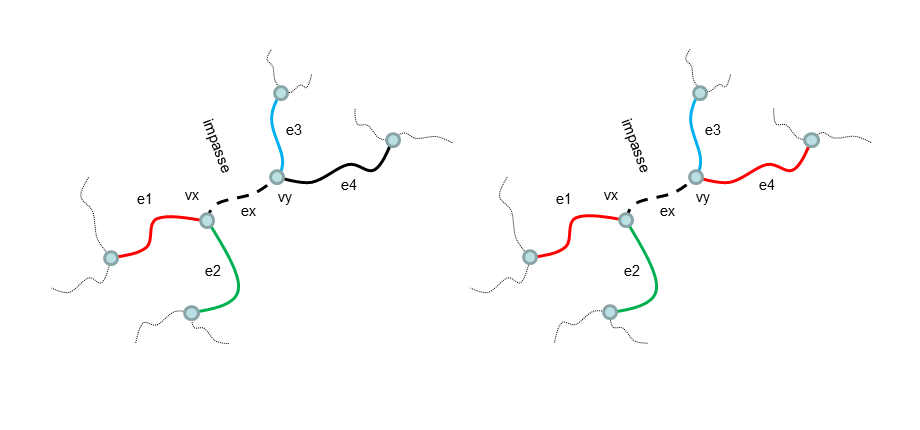
Lets say you are coloring (Red, Green, Blue) the edges of a map and have properly colored a portion of it, as in the example. At a certain point you get to a vertex that has two edges already colored, for example with Red and Green (e1, e2). In this case you’d be forced to select the color Blue for the uncolored edge (ex). But it is possible that the color Blue is already used by one of the other two edges starting from vy (e3). This situation is called impasse. In the example e4 may be already colored or not, the impasse remains.

SECOND: Apply Kempe chain color swapping and problems using it

tait-and-kempe-coloring-switch-v4

One technique that can be used to solve an impasse is to apply a Kempe chain color swapping. But the problem is that this Kempe swap does not always work. This happens when the Kempe swap does not only change the color of the edge that caused the impasse (e4), but also the color of one of the other three edges involved in the impasse (e1, e2, e5 in the example).

To better understand Kempe chain color swapping, lets analyze, step by step, the labeled part the graph showed above:

  • Impasse: Since e1 and e2 are colored Green and Blue, e3 should be colored Red. But this color can’t be used because Red is already used by e4
  • To solve this impasse you can try to apply a Kempe chain coloring swapping
  • The possibilities are: (R-G)-chain and (R-B)-chain that change the color of e4
  • (R-G)-chain, involving e4 and e5 would not work, because R would end up in e5, not changing the situation … even if the continuation of the chain arrives to the vertex a
  • (R-B)-chain has a better chance to work, because would set e4 with color B, sometimes solving the impasse. I said sometimes because this is true only if the (R-B)-chain does not arrive to vertex b, swapping also the color of e2, in which case would simply mirror the problem between the vertices c and d

THIRD: Hypothesis to solve the second impasse when Kempe swap fails

Using the Java application I wrote, I started experimenting Kempe chain color swapping and found many situation where the swapping would not solve the impasse, but I also found a method, which of course needs to be proved, to solve the second impasse when Kempe chain color swapping fails (fallacious Kempe chain color swapping). If true (consider that what is written in this blog are just personal notes about an attempt) this would prove the four color theorem a very short and elegant way.

<insert video>

Hypothesis:

The hypothesis I’d like to verify is that from maps in which F2, F3, F4 faces have been previously removed (which is safe for the proof of the theorem), the fallacious Kempe chain can always be “broken” (or in different words: its path changed) along the way (using another Kempe chain coloring swap) to avoid the second impasse. After this “cut”, the original swap can be performed to solve the original impasse.

I tried this method on many maps with and without F2, F3, F4 faces, and so far it seems to work … always.

Here is an example:

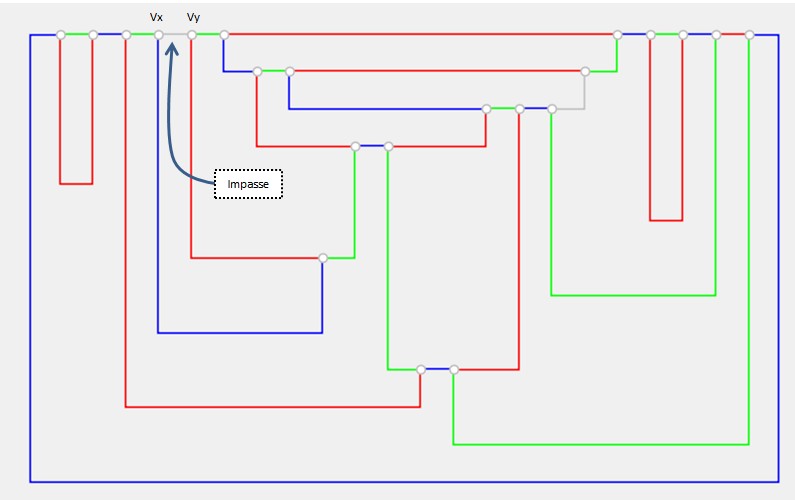
impasse-kempe-chain-fallacious-v5

In this example:

  • There is an impasse between Vx and Vy. On Vx color Green could be used for the edge connecting Vx and Vy but Green is already used by e4
  • (G-R)-chain (…-e4-e3-…) swap does not work because, e4 and e3 will simply swap colors and Vy will still have a Green color starting from it
  • (G-B)-chain (e4-e5-…) swap does not work because the chain ends up to e1 (to the vertex Vx) and the impasse will remain
  • The hypotesis, that works for this example and all examples I found (maps without F2, F3, F4), is that che (G-B)-chain can be “broken” using a color swapping of the (B-R)-chain at (…-e5-e6-…), and after this swap you can apply the original (G-B)-chain color swap, that will solve the impasse. By contrary I found many example for maps containg F2, F3, F4 in which this hypotesis is not true

To be finished:

  • Insert example of maps containing F2, F3 or F4 where the second Kempe chain swap does not solve the impasse
  • Insert other examples of impasses with maps without F2, F3, F4
  • Insert video examples of impasses with maps without F2, F3, F4, that can be solved by “cutting” the fallacious chain

Four color theorem: new video and new software


In the new version of the software, isomorphic graphs are automatically removed while processing. This way the generation of all graphs/maps is a lot faster … not as plantri but faster than before.

Download it from here: https://github.com/stefanutti/maps-coloring-java

Using it, I generated all simplified graphs, in graphml format, up to 18 faces:

Here is the video on YouTube:

Four color theorem: simplified maps and fullerenes (answer)


After having posted the question on mathoverflow, the answer arrived in a blink of an eye.

Here is the answer from Gordon Royle:

Use Gunnar Brinkmann (University of Ghent) and Brendan McKay (Australian National University)’s program “plantri” …

You will discover that there are:

  • 3 on 16 faces (as you said)
  • 4 on 17 faces
  • 12 on 18 faces
  • 23 on 19 faces
  • 73 on 20 faces

and then going to Sloane’s online encylopaedia you discover: https://oeis.org/A081621

So in short, the answer to your question is “yes, the sequence is fairly well known”.


From plantri http://cs.anu.edu.au/~bdm/plantri:

3-connected planar triangulations with minimum degree 5 (plantri -m5), and 3-connected planar graphs (convex polytopes) with minimum degree 5 (plantri -pm5).

plantri -pm5uv 12
plantri -pm5uv 13

.
nv ne nf | Number of graphs
12 30 20 | 1
13 33 22 | 0
14 36 24 | 1
15 39 26 | 1
16 42 28 | 3
17 45 30 | 4
18 48 32 | 12
19 51 34 | 23
20 54 36 | 73
21 57 38 | 192
22 60 40 | 651
23 63 42 | 2070
24 66 44 | 7290
25 69 46 | 25381
26 72 48 | 91441
27 75 50 | 329824
28 78 52 | 1204737
29 81 54 | 4412031
30 84 56 | 16248772
31 87 58 | 59995535
32 90 60 | 222231424
33 93 62 | 825028656
34 96 64 | 3069993552
35 99 66 | 11446245342
36 102 68 | 42758608761
37 105 70 | 160012226334
38 108 72 | 599822851579
39 111 74 | 2252137171764
40 114 76 | 8469193859271

Four color theorem: simplified maps and fullerenes


Analyzing all 3-regular graphs that have only faces with 5 edges or more (simplified), I empirically found (using a computer program) that many hypothetically possible graphs, that by Euler’s identity may exist (F5=12+F7+2F8+3F9+...), do not actually exist. Using a VF2 algorithm to filter out isomorphic maps, I also noticed that not so many graphs as I expected existed. And that one general category of graphs, that always represents a simplified 3-regular graph, is that of Fullerenes (with 12 faces F5 and an arbitrary number of F6). Here is a list of what I found, so far, for each class of graphs, from 12 faces to 20 faces (surrounding area included).
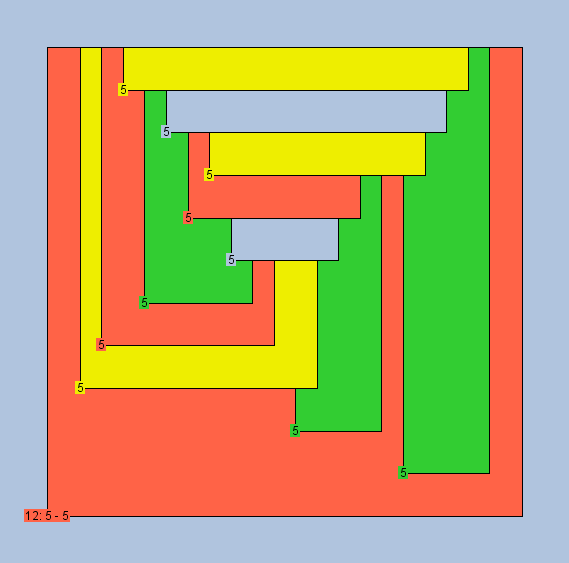
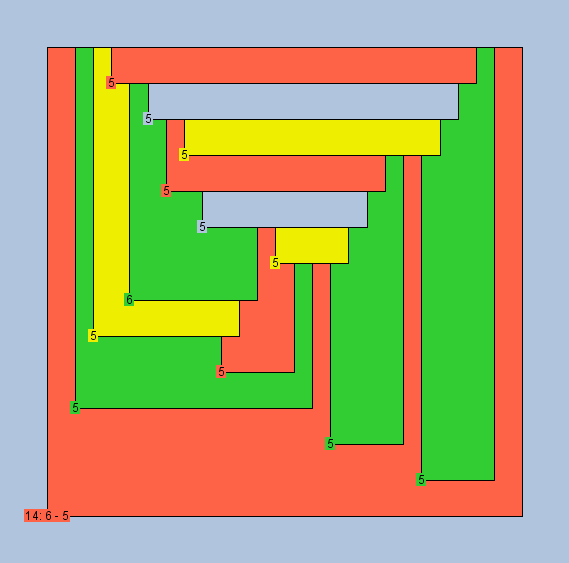
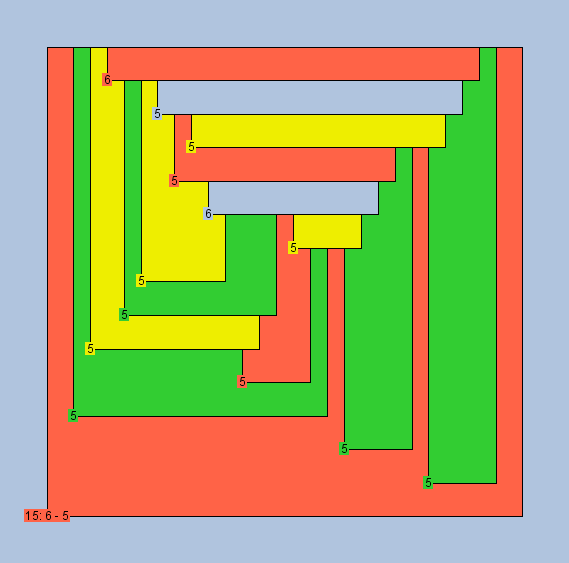
The question is: Since the computation of maps with 17, 18, 19, 20 faces (simplified and not containing isomorphic graphs) it is taking me very long time (days of CPU time on a PC), is this sequence already known?

I did post this question on: math.stackexchange.com

  • 12 faces: 1 (only 1 graph exists)
    • On 3 dimentional space (sphere) it is a dodecahedron
    • It is a fullerene: 20-fullerene Dodecahedral graph
  • 13 faces: 0 (no simplified graphs exist with 13 faces)
    • The hypothetical (by Euler’s identity) map of 12 F5 and 1 F6 does not exist
  • 14 faces: 1 (12 F5 + 2 F6)
    • The hypothetical (by Euler’s identity) map of 13 F5 and 1 F7 does not exist
    • It is a fullerene: GP (12,2) Generalized Petersen graph
  • 15 faces: 1 (12 F5 + 3 F6)
    • The hypothetical (by Euler’s identity) map of 14 F5 and 1 F8 does not exist
    • It is a fullerene: 26-Fullerene
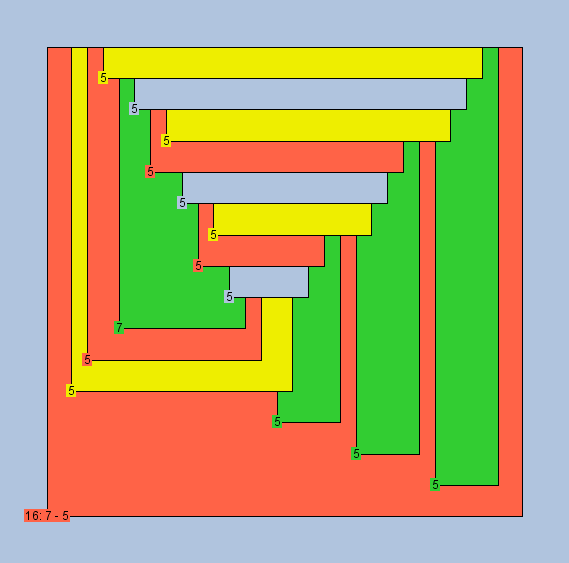
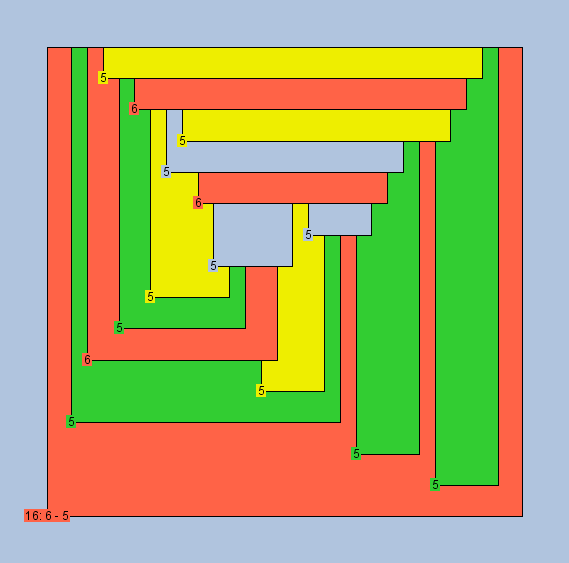
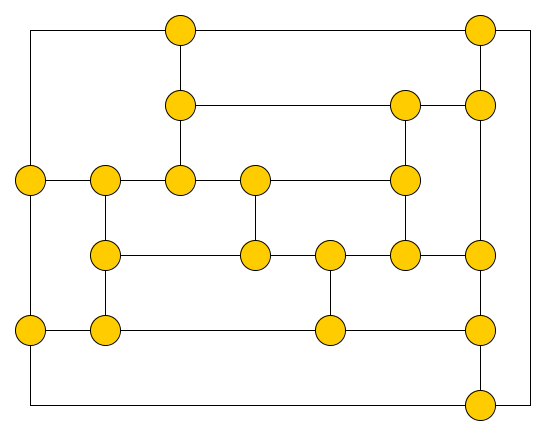
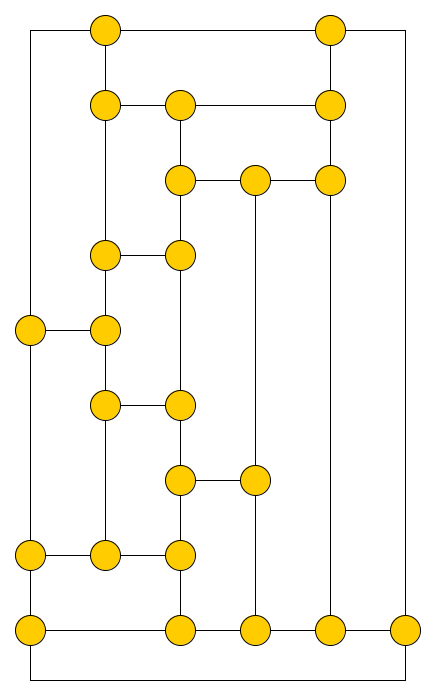
  • 16 faces: 3 (Two graphs are 12 F5 + 4 F6. The other has 14 F5 + 2 F7)
    • The hypothetical (by Euler’s identity) map of 14 F5 and 2 F7 does exists
    • The other two are Fullerenes
  • 17 faces: ???
  • 18 faces: ???
  • 19 faces: ???
  • 20 faces: ???

Many fullerenes are here: http://hog.grinvin.org/Fullerenes.

Last things implemented in the Java program (github):

  • Save and restore all lists (maps and todoList) to disk
    • Done: 19/Gen/2013
  • Verify the various filters when generating maps
    • Done: 19/Gen/2013
  • Browse the todoList
    • Done: 20/Gen/2013

Here are the maps … four colored … up to 16 faces (ocean included):

12 14 15
16 16 16

And the same graphs elaborated using yWorks:

12 14 15
16 16 16