In terms of graph theory I’d like to find all four colorings of the vertices of a planar graph (the dual representing the map).
I’m interested in maps in which each face is an opaque rectangle layered on all previous rectangles, overlapping partially. Each consecutive rectangle starts at a consecutive y coordinate. The next picture should better clarify what I mean.
The faces are numbered from 1 to n
face 1 is the face on the bottom of the pile
face (n-1) is the face at the top
face n is the infinite face surrounding all others
For the meaning of different colorings you can refer to this question: mathoverflow.net
I was thinking to pre-set the colors of faces and use a classical brute force algorithm to get four coloring of the map. I already implemented the brute force algorithm to find the proper coloring of a map and I can also force the color of faces to find particolar colorings.
The problem is that I’m not coming up with an algorithm to do it automatically and to be sure to find ALL colorings.
To see what I have so far, you can watch this video on youtube:
!
What I know is that:
Since the colors of three neighbors faces can be arbitrary, face number n, face number 1 and the face touching both (face n and face 1), can have these fixed colors: blue, red, green


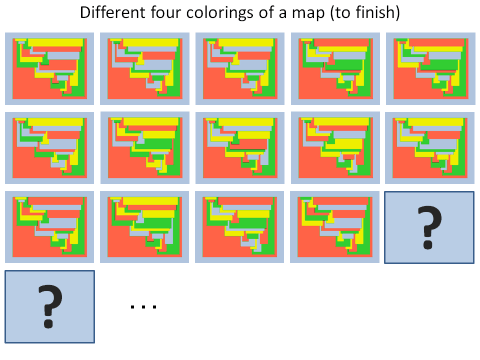
 Four Color Theorem